If you are a USA based occupational therapy practitioner, you likely already know that its been YEARS since insurance companies have increased our fee schedule. A fee schedule is the contractural arrangement in which occupational therapy is reimbursed by insurance companies. Medicare is the main player and their fee schedules set precedent for Medicaid and commercial insurance payers.
I can really only speak to North Carolina Medicaid since its the only state I’ve ever billed insurance, but I’m guessing this may feel like other states.

North Carolina Medicaid Hasn’t Kept Up: What OT Codes Pay vs. What It Costs (2010 → today)
North Carolina moved to managed care in 2021, but most outpatient OT clinics still feel like we’re billing 2008 in a 2025 economy. The fee schedule tells the story.
The receipts (NC Medicaid / NCTracks)
- Therapeutic activities (97530):
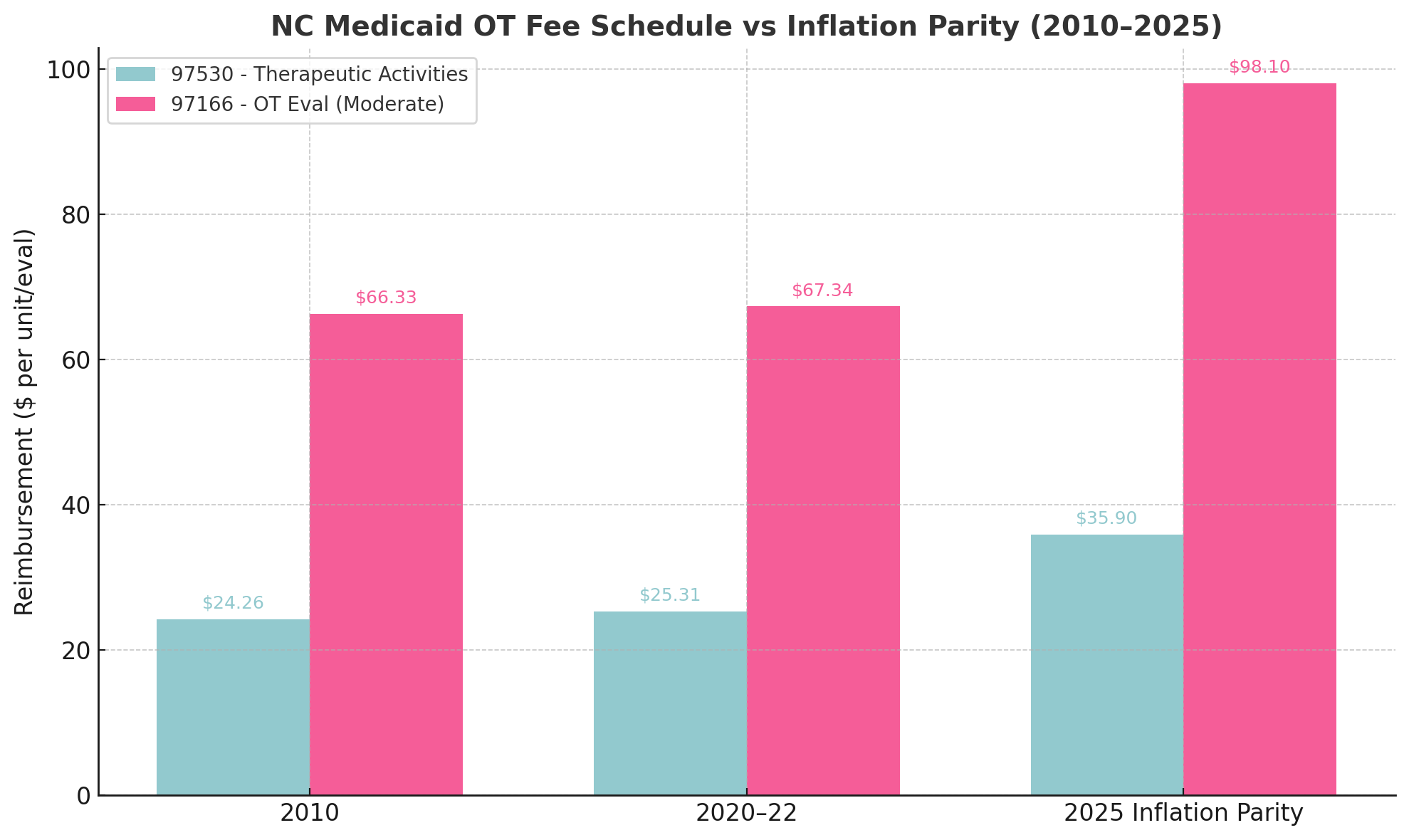
- $24.26 per 15-min unit in 2010 (non-facility). NC Medicaid
- $25.31 per 15-min unit in 2020–2022 (non-facility). NC Medicaid
- Net change: about +$1.05 in 12 years (nominal).
- OT evaluation
- 97003 (legacy): $66.33 in 2010. NC Medicaid
- 97166 (moderate): $67.34 in 2020–2022. NC Medicaid
- Net change: +$1.01 (nominal)
Context: NC Medicaid went live with managed care July 1, 2021. Plans use contracted rates with rate-floor fee schedules in their contracts, but the published fee schedules still function as the practical baseline most clinics see.
What those dollars mean in 2025
- Inflation since 2010 ≈ 48%. $1 in 2010 needs ≈ $1.48 today to break even. In 2013 Dollars
- Translate that to therapy:
- 97530 would need to be ≈ $36 today just to equal its $24.26 value in 2010 (24.26 × 1.48 ≈ 35.9). NC Medicaid’s $25.31 is ~30% short of inflation parity. (Math shown; inflation source above.) NC Medicaid+1In 2013 Dollars
- 97166 would need to be ≈ $98 today to equal $66.33 in 2010 (66.33 × 1.48 ≈ 98.1). Current $67.34 is ~31% under inflation parity. NC Medicaid+1In 2013 Dollars
- Since 1998, general prices have nearly doubled (+98%). So if OT rates were flat or near-flat in the 2000s, the real value of an OT unit has been cut roughly in half. In 2013 Dollars
“Real-life” clinic math (why it feels impossible)
- Typical medical practice overhead runs 60–70% of revenue (rent, admin, software, insurance, billing, supplies, taxes). 99mgmt.com
- OT wages: BLS shows $98,340 U.S. median (May 2024); NC average ≈ $94,580. That’s about $45–$47/hour before benefits. Bureau of Labor StatisticsO*NET OnLine
Put it together for Medicaid 97530 at $25.31/unit (four units/hour = $101.24/hour gross):
- Overhead (60–70%): $60–$71/hour out the door. 99mgmt.com
- Leftover to pay your OT’s wage+benefits: $30–$41/hour — below typical fully-loaded clinician cost. Net: you lose money unless productivity is pushed past what’s clinically sane, or non-Medicaid payers subsidize Medicaid.
For comparison, Medicare pays roughly mid-$30s per unit for 97530 nationally in 2024 (varies by locality). That’s still tight, but it’s notably higher than NC Medicaid’s ≈$25. empoweremr.comCenters for Medicare & Medicaid Services
The blue is what the fee schedule IS and the pink is where it should be in order to account for inflation.

Other providers got raises (and why that matters)
- Primary care & dental: NC Medicaid raised primary care rates to Medicare levels and dental +10% in recent years to stabilize access. North Carolina Files
- Behavioral health: In Nov 2023, the state announced “first time in a decade” increases across mental health/SUD/I/DD/TBI. NC DHHSAxios
- 2025 House budget (proposal): 3% Medicaid increases for several provider groups, including speech-language therapy, optometry, podiatry, etc. (OT wasn’t explicitly listed in that report). North Carolina Health News
Takeaway: North Carolina is willing to adjust rates when access is at risk — but outpatient OT hasn’t seen commensurate, inflation-aware updates in its core codes.
Why “managed care” didn’t fix it (yet)
Managed care adds care-coordination, quality metrics, and the possibility of state-directed payments and rate floors, but it doesn’t magically lift base OT rates. Plans still anchor to state fee baselines unless you negotiate. If OT can prove avoidable costs reduced and functional outcomes improved, you’ve got leverage for above-floor rates.
How NC OTs Can Advocate (and win) in 2025
1) Lead with evidence that speaks payer-language
Metrics that resonate with Medicaid and health plans:
- Time to functional milestone (e.g., goal attainment within X visits).
- Care intensity → outcome curve (doses/units vs. gains).
- Episode cost and reduced downstream spend (fewer ED visits, less specialty escalation, shorter LOS after surgery).
- School/IEP-relevant gains (attendance, participation) for kids covered under EPSDT — align to policy language. NC Medicaid
2) Use O.T. Wizard as a longitudinal outcomes engine
This is where OT Wizard can be your differentiator:
- Standardize eval templates to capture baseline participation & function (COPM/GOAL-ATTAINMENT or your preferred measure) and auto-score session-level progress.
- Track cohorts across diagnosis, age, frequency, modality (clinic/home/tele).
- Auto-generate quarterly payer dashboards: time-to-goal, units per successful episode, no-show rate impact, discharge status, re-referral rates.
- Export plan-ready PDFs/CSVs tagging CPT mix (97530, 97110, 97535, 97166) → outcome → cost per episode.
- Build pre/post comparisons on commonly denied diagnoses to show where 15–30% more units drive measurable functional gains (and where they don’t).
3) Make a targeted rate ask
- For NC Medicaid Direct: reference the documented stagnation — 97530 and evals are ~30% below inflation parity from 2010. Ask for an inflation alignment step-up (e.g., $36/unit target for 97530). NC Medicaid+1In 2013 Dollars
- For Managed Care plans: request above-floor OT carve-outs or value-based add-ons using your outcomes package. Point to recent BH & primary care raises as precedent that the state is willing to move rates when access is at stake. NC DHHSAxiosNorth Carolina Files
4) Coalition up
- Partner with PT & SLP peers and pediatric systems to show waitlists, turnover, and geographic gaps tied to low OT rates.
- Bring parent/teacher testimonials plus quantified access delays (days to eval; cancellations due to network gaps).
- Align with legislative interest: point to the 2025 House budget considering rate bumps for other services (ask, “Why not OT?”). North Carolina Health News
5) Keep the policy receipts handy
- Cite NC’s managed care launch and rate-floor guidance to show plans have levers; you’re asking them to use those levers for OT. NC Medicaid+1
- Anchor your “ask” to CPI (BLS) so it’s not an emotional plea; it’s math. In 2013 Dollars
Bottom line
- NC Medicaid’s 97530 and OT eval amounts have barely budged nominally since at least 2010; in real dollars, they’ve fallen ~30% versus inflation. NC Medicaid+1In 2013 Dollars
- The state has shown it will raise rates (primary care, dental, behavioral health) to protect access — OT should be next. North Carolina FilesNC DHHS
- Use OT Wizard to produce longitudinal outcome evidence and push for inflation-aligned floors (and plan-level add-ons) so clinics can actually hire, retain, and serve. 💕
Leave a Reply