Category: Billing and regulatory

Billing and regulatory issues in the field of pediatric occupational therapy, both in school based and clinic based settings.

  • Why OTP’s need better assessments-update on the FMSAT

    Why OTP’s need better assessments-update on the FMSAT

    Measuring Neuromotor Lateralization Across the Lifespan: Progress on the FMSAT Norming Project (& Why OTP’s need better assessments)

    How a one-minute screener for hand dominance, modern Rasch psychometrics, and the shift to value-based care are converging to change how occupational therapists, educators, and clinicians measure what we do.

    Published May 24, 2026 by Stephanie Seymore Wick, MSOT, OT/L · Founder, Learning Charms and O.T. Wizard

    A short progress note before we go deeper

    Every week I send out an update to the therapists, educators, and clinicians contributing to the FMSAT norming project. The updates focus on data, leaderboards, and the age bands we still need to fill. This week the data deserves a deeper look than a weekly email can carry. The findings touch on questions that go well beyond a single screener, including how our profession measures what we do, how those measurements connect to insurance reimbursement, and why occupational therapy salaries have not kept pace with the cost of becoming an OT.

    If you are a pediatric occupational therapist who has ever had to defend a Beery score at an IEP meeting that did not match the child sitting in front of you, this post is for you. If you are an educator looking for a fast, fair screening tool to identify students who may benefit from earlier support, this is for you. If you are an adult-focused OT, a neurology specialist, or a clinician working with progressive motor conditions, this is for you too. And if you are an OT, OTA, or therapy leader thinking about the coming shift to value-based care and what it means for your practice, this is also for you.

    Here is what is in this post:

    • What the FMSAT is, what it actually measures, and why it works across the lifespan
    • How the FMSAT can be used as a one-time screener, a progress monitoring tool, and a lifelong tracking instrument
    • What Rasch analysis is, in plain English, and why it is considered the gold standard in modern assessment
    • The first Rasch results on the FMPRS, our companion rating scale
    • What ecological validity means and why your favorite assessments may be missing it
    • Why the FMSAT itself uses Classical Test Theory and the FMPRS uses Rasch
    • Why value-based care is about to make all of this matter more than it ever has before
    • How the O.T. Wizard platform, soon to be rebranded as MyTherapyWizard, fits into the bigger picture

    A note on terminology before we go further

    Throughout this post you will see three terms that are sometimes used interchangeably but mean different things in occupational therapy practice and in psychometrics. Getting the distinction right matters because the FMSAT is one of those terms and not the others.

    A screener is a brief, low-burden tool designed to flag people who may benefit from further evaluation. Screeners take a minute or two, can often be administered by people without specialized clinical training, and produce a simple signal that says proceed to next step or no further action needed. Screeners do not diagnose, do not establish eligibility, and do not produce a comprehensive clinical picture. Examples in healthcare include the M-CHAT for autism, the PHQ-9 for depression, and vision and hearing screens in schools.

    An assessment is a more comprehensive structured evaluation that produces detailed information sufficient to support diagnosis, eligibility decisions, and treatment planning. Assessments typically take 30 to 90 minutes, require trained administrators, and produce multiple subscores or domain scores. Examples in pediatric OT include the Beery-Buktenica Developmental Test of Visual-Motor Integration, the Peabody Developmental Motor Scales, the Bruininks-Oseretsky Test of Motor Proficiency, the Sensory Processing Measure, and the Pediatric Evaluation of Disability Inventory Computer Adaptive Test (PediCAT).

    An evaluation is the broader clinical process that uses one or more screeners and assessments together with observation, interview, and chart review to produce a full clinical picture and recommendations.

    The FMSAT (Fine Motor Speed and Accuracy Test) is a screener. It is not designed to replace any assessment in your toolkit. It is designed to do the screener job well, which means flagging test takers who may benefit from a comprehensive evaluation when their lateralization or fine motor speed scores fall outside expected ranges. The assessments that follow a positive FMSAT screen will be whatever your clinical reasoning and your setting indicate. The point of a good screener is to make sure the right people get to those assessments faster than they would have otherwise.

    The FMPRS (Fine Motor Participation Rating Scale), on the other hand, is functioning more like a brief assessment instrument during the validation phase of this project, because its job is to produce the multi-domain rating data needed to establish ecological validity for the FMSAT. After validation is complete, the FMPRS will not typically be used alongside the FMSAT in routine clinical screening.

    What the FMSAT measures and why it works across the lifespan

    The FMSAT, which stands for Fine Motor Speed and Accuracy Test, is a one-minute screener. The test taker is given a bubble-popping worksheet and asked to pop as many bubbles as they can in 30 seconds with one hand, then 30 seconds with the other hand. The score for each hand is the number of bubbles popped. That is it. No rater training, no expensive test kits, no proprietary materials beyond a printed worksheet.

    The name says fine motor speed and accuracy, and that is what each hand score reflects. But the construct the instrument was designed to measure, and the reason the two hands are tested separately, is neuromotor lateralization. Lateralization is the degree to which a person has committed one side of the brain, and therefore one hand, to specialized motor work. Strong lateralization means the dominant hand performs precision tasks fluently while the non-dominant hand serves as a stabilizer. Weak or absent lateralization means the two hands perform more similarly, hand preference is inconsistent, or the person switches hands mid-task. Fine motor speed is the metric we use to detect that pattern, because timed performance under demand reveals the lateralization signal more clearly than untimed observation does.

    This matters because lateralization is not just a developmental milestone of early childhood. It is a lifelong neuromotor property that emerges during the preschool years, consolidates through school age, holds through adulthood, and can shift or erode in response to neurological changes later in life. The FMSAT was designed to capture that lateralization signal at any age, which is why our normative dataset spans from preschool through older adulthood rather than stopping at age 12 or 17.

    What makes the FMSAT useful is not the bubble popping itself. It is what the two hand scores together tell us about how well a person has consolidated hand dominance, and how that pattern compares to typical lateralization for their age. The dominant hand score reflects fine motor capability. The difference between the two hands reflects lateralization. Both pieces of information matter for clinical and educational practice, and neither one is captured well by the standardized assessments most occupational therapists currently use.

    How the FMSAT can be used: one-time screener, progress monitoring, and lifelong tracking

    Because the FMSAT is fast, standardized, and produces a numeric score, it can support several clinical and educational use cases that most current assessments cannot. Three are worth naming explicitly.

    Use case 1: One-time screening for hand dominance and fine motor concerns

    This is the most familiar use case. A pediatric occupational therapist, school OT, or educator administers the FMSAT to a student who has been flagged for fine motor concerns, handwriting difficulty, or unclear hand dominance. The score, compared to age-appropriate normative bands, gives a quick objective marker of whether the student’s performance and lateralization fall within expected ranges. This is the use case the validation manuscript will focus on first.

    Use case 2: Response to Intervention and progress monitoring

    Because the FMSAT takes one minute and produces a numeric score, it can be re-administered at intervals to track whether a person is making measurable progress over time. This is exactly the kind of brief repeatable measurement that Response to Intervention frameworks and Multi-Tiered Systems of Support models require. A school OT could administer the FMSAT at the start of an intervention block, midway through, and at the end, and have objective data showing whether the lateralization or fine motor speed measure is changing in response to the intervention. A clinic-based OT could do the same across a course of therapy. The same minimum-detectable-change thresholds that value-based payment models are increasingly requiring would apply directly. Once the normative dataset is finalized, the FMSAT becomes one of the few fine motor measures fast enough to use for routine progress monitoring.

    Use case 3: Educator-administered screening in school settings

    The FMSAT requires no rater training and no clinical interpretation to administer. A teacher, paraprofessional, school nurse, or interventionist can give the test and record the scores. With enough normative data in place, the score itself does the screening work and a teacher does not need to be an OT to identify a student who falls below the expected band. This opens the door to universal screening at the classroom or grade level, the same way schools currently screen vision and hearing. Students flagged by the screener can then be referred to occupational therapy for full evaluation. This is a long-term vision rather than an immediate use case, but it is exactly the kind of MTSS Tier 1 screening application that schools have been asking for and that occupational therapy has not yet had the tools to support.

    Use case 4: Lifespan monitoring, including progressive neuromotor conditions

    This is the use case that emerges directly from norming the FMSAT across all ages rather than only in pediatrics. Lateralization can shift across the lifespan in response to neurological events and conditions. A person recovering from stroke may show changed dominant-hand performance. A person living with multiple sclerosis, Parkinson’s disease, or another progressive neuromotor condition may show gradual erosion of the lateralization signal as the condition advances. A person experiencing age-related changes in motor control may show compression of the dominant-hand advantage. The FMSAT, administered periodically, could detect those shifts earlier and more objectively than self-report or general clinical observation. With enough normative data across all ages, the same one-minute test that screens a five-year-old for emerging hand dominance could monitor a 55-year-old neurologist for early signs of motor change in the years after a diagnosis. That is the broader clinical reach the lifespan normative dataset makes possible.

    None of these use cases require a separate test. They all use the same one-minute bubble-popping task. What changes is who is administering it, how often, and what the score is being compared against. That flexibility is one of the reasons we are investing in the validation work the way we are.

    What is Rasch analysis and why is it considered the gold standard?

    Many occupational therapy assessments you have used in your career, including those most commonly used to demonstrate progress in pediatric settings, were developed using Classical Test Theory, often shortened to CTT. The Beery-Buktenica Developmental Test of Visual-Motor Integration, the Bruininks-Oseretsky Test of Motor Proficiency, the Peabody Developmental Motor Scales, and the Sensory Processing Measure are CTT-based instruments. CTT produces a total score that is then compared to a normative sample. The score tells you where a test taker falls relative to peers, but it has some real limitations.

    The biggest limitation is that CTT treats every item on a test as if it were equally difficult, and every point on the score scale as if it represented the same amount of skill. A test taker who scores 84 versus one who scores 89 may differ by a meaningful amount of skill, or may differ by almost nothing, depending on where on the scale those scores fall and which specific items they got right. CTT cannot tell you which.

    This is true for both screeners and assessments built under CTT, though the limitation is more consequential for assessments because assessments are doing more of the clinical decision-making work. A screener producing a CTT score is still useful as a yes/maybe/no signal. An assessment producing CTT scores is being asked to support diagnosis, eligibility, and treatment planning decisions on the same imprecise measurement scale.

    Rasch analysis, developed by Danish mathematician Georg Rasch in the 1960s, takes a fundamentally different approach. Rasch places each test item and each person on the same interval scale, called the logit scale. This means the distance between a score of 5 logits and 10 logits represents the same amount of skill change as the distance between 20 and 25. Rasch also calibrates each item individually, telling you which items are easy, which are hard, and whether each item is actually pulling its weight in measuring the construct.

    Rasch is to assessment what a ruler is to measurement. CTT scores tell you a child is somewhere in the middle. Rasch scores tell you exactly where, on a scale where the units are equal.

    Rasch analysis is considered the gold standard for modern instrument development because it is the framework used by some of the most respected and most defensible pediatric assessments in the field. The PEDI-CAT, the AMPS or Assessment of Motor and Process Skills, the School Function Assessment, and the WeeFIM are all Rasch-based or Item Response Theory based instruments. These are the tools that produce data insurance companies and researchers trust. If you have ever wondered why some assessments seem to have stronger research backing than others, the framework behind them is usually a big part of the answer.

    Behind the scenes: the first Rasch checkup on the FMPRS

    The FMPRS, or Fine Motor Participation Rating Scale, is the 12-item observer-rated companion to the FMSAT. It captures four dimensions of fine motor function across real-world tasks: fine motor speed, fine motor precision, laterality and bilateral differentiation, and participation in daily roles. Our Rasch consultant, Angie, ran the first calibration on 139 paired FMSAT and FMPRS records earlier this month. The results were strong for a first calibration on a relatively small sample.

    Finding one: the item difficulty order matches the developmental theory

    Rasch ordered the 12 items from easiest to hardest based on how raters actually responded to them. The Laterality items, which ask about hand dominance and bilateral hand use, came out as the easiest. The Participation items, which ask about sustained engagement in fine motor tasks throughout the day, came out as the hardest. This is exactly what we would predict developmentally. Hand dominance consolidates earlier in childhood than sustained occupational engagement, so on a rating scale measuring fine motor function across the developmental arc, laterality items should be easier to endorse than participation items. The data confirmed the theory.

    Finding two: the instrument separates clinical and typical test takers cleanly

    On the Rasch-derived person measure, typical preschoolers scored more than two logits higher than clinical preschoolers. In plain terms, the typical preschooler scored higher than approximately 98 percent of the clinical sample. This is what is called a known-groups validity effect, and a Cohen’s d effect size above 2.0 is unusually strong. Most pediatric assessments are pleased to show known-groups effects in the 0.5 to 0.8 range. The FMPRS is producing separation that is roughly three times stronger. As the normative dataset grows beyond preschool ages, we expect the same separation pattern to extend across older age bands and into adult populations where clinical and typical comparison groups can be defined.

    Finding three: the FMPRS and the FMSAT are picking up the same underlying construct

    The Rasch-derived person measure on the FMPRS correlated with FMSAT dominant hand scores at r = 0.575. That correlation tells us that two completely different methods of measurement, a one-minute performance task and a 12-item observer rating scale, are picking up the same underlying construct. This is exactly the kind of cross-method convergence a strong validation manuscript needs.

    What still needs work

    Five items in the FMPRS came back as overfitting in the Rasch model, which means they are too internally redundant. They are not bad items. They are just not adding as much new information as they could. Those items will be revised for the next version of the FMPRS based on what the calibration showed us. This kind of iterative refinement is how serious instrument development works, and it is exactly why we are doing this calibration now, before the manuscript is finalized.

    Ever wondered why Beery, PDMS-3, or BOT-2 scores do not match real-world function?

    Here is a question every occupational therapist has wrestled with at some point in their career. Why do scores from the Beery-Buktenica VMI, the Peabody Developmental Motor Scales, or the Bruininks-Oseretsky Test sometimes fail to line up with what you actually see in the classroom, at home, on the playground, or in adult daily life?

    You are not imagining it. A student can score below average on a tabletop visual motor task and still write legibly, manage their lunchbox, and participate fully in PE. Another can score in the average range and still struggle every single day to keep up with handwriting demands or self-care routines. The same pattern shows up in adult assessments. The mismatch is real, and it has a name in the psychometric literature. It is called an ecological validity gap.

    What ecological validity actually means

    Ecological validity is a psychometric term that answers a simple question: does this assessment measure something that actually matters in real life? An instrument with strong ecological validity produces scores that connect to how a person functions in their daily environment. An instrument with weak ecological validity produces scores that connect mainly to how a person performs on the test itself, with limited evidence that the score predicts daily function.

    Many of the assessments OTs use most often were designed to measure isolated motor performance, not real-world participation. They are good at what they measure. They were just never built to answer the participation question. When a school-based therapist is asked to defend a Beery standard score at an IEP meeting, or when a clinic-based therapist is asked to justify medical necessity to an insurer using a PDMS-3 score, the underlying problem is often that the score is being asked to do something the assessment was not designed to do.

    Why the FMPRS is essential to FMSAT validation, even though clinicians will not use both in practice

    Here is a question that comes up almost every time I explain this project. If the FMSAT is a screener, why pair it with the FMPRS at all? Won’t clinicians be expected to do both?

    The answer is no. The FMPRS is doing critical work right now, during validation, so that the FMSAT will not need to be paired with it in clinical practice later. The whole value of the FMSAT as a screener depends on it being a one-minute, paper-and-pencil, standalone score. Asking clinicians to also complete a 12-item rating scale every time they administered the screener would defeat the entire point of having a screener in the first place.

    What the validation work establishes, and what every paired FMSAT and FMPRS submission helps establish, is that when the FMSAT score is elevated or compressed in a particular way, it is reflecting something that shows up in the test taker’s real-world functional life. Once that link is established and published in a peer-reviewed manuscript, the FMSAT score on its own carries that ecological meaning forward. Clinicians using the FMSAT in practice will be able to point to the published validation evidence rather than having to demonstrate the connection every time.

    This is the same approach used to validate other widely accepted screeners. The Modified Checklist for Autism in Toddlers, known as the M-CHAT, was validated against full ADOS and ADI-R diagnostic batteries. Pediatricians using the M-CHAT today do not run an ADOS alongside it. The validation work was done once and the screener now stands on its own. The PHQ-9 depression screener was validated against structured psychiatric interviews. Primary care providers use it on its own today. The pattern is consistent across well-validated screeners. Validate against a richer companion measure once, publish the validity evidence, then use the screener on its own.

    Why the FMSAT itself uses Classical Test Theory and the FMPRS uses Rasch

    This is a question that any sharp reader will be asking by now. If Rasch is the gold standard, why is the FMSAT being calibrated using Classical Test Theory rather than Rasch?

    The answer comes down to the measurement structure of each instrument. The FMSAT produces raw bubble counts on a zero to 80 scale for each hand. That kind of continuous count data is well-suited to CTT-style descriptive statistics, percentile norms, and known-groups validity comparisons. These are the analyses the FMSAT validation manuscript will lean on, and they are the analyses that produce the percentile bands and severity cutoffs clinicians actually use at the point of care.

    Rasch is the right framework for the FMPRS because the FMPRS uses ordered category responses on a four-point scale, and each item can be at a different difficulty level on the same underlying trait. That is exactly the kind of measurement structure Rasch was designed to handle. The two instruments are built differently on purpose, and each one is being analyzed using the framework that fits its measurement structure.

    The Rasch work on the FMPRS gives the manuscript the modern psychometric backbone peer reviewers expect. The CTT work on the FMSAT keeps the screener simple and interpretable for the clinicians who will actually use it. Both pieces matter, and together they create a defensible validation argument.

    Why value-based care is about to make all of this matter much more than it has before

    If you have been practicing for more than a few years, you already know that occupational therapy reimbursement has been under pressure for a long time. The 2026 Medicare Physician Fee Schedule final rule from the Centers for Medicare and Medicaid Services, released October 31, 2025, continued a trend of flat or declining payment rates for outpatient OT. According to OT Potential’s 2026 reimbursement analysis, the proposed 1% decrease to OT and PT relative value units for 2026 came after a 0% increase in 2025 and a 3% decrease in 2024. The trajectory is real and most OTs feel it directly in their paychecks.

    What is changing right now, and what most clinicians have not fully internalized, is that the structure of the entire payment system is shifting underneath us. The shift is called value-based care.

    What value-based care actually means

    Value-based care is a payment model where providers and health systems are reimbursed based on the outcomes their patients achieve, not the volume of services delivered. Under traditional fee-for-service payment, an OT bills for each visit and gets paid for each visit. Under value-based care, payment is increasingly tied to whether the patient demonstrated measurable functional improvement against established benchmarks.

    CMS has been driving this shift through several specific programs. The Quality Payment Program, the Merit-based Incentive Payment System known as MIPS, and an expanding suite of Alternative Payment Models are all moving rehabilitation services toward outcomes-based reimbursement. The 2026 payment updates included a 0.75% increase for qualified APM participants and a 0.25% increase for everyone else, an early but clear signal that participating in alternative payment models will increasingly be where the financial upside is.

    The era of writing patient made progress toward goals in a discharge note and being reimbursed for it is ending. The era of demonstrating measurable functional change against defensible benchmarks is beginning.

    Why occupational therapy is structurally underprepared for this shift

    Here is the connection most clinicians have not drawn explicitly. The shift to value-based care requires outcomes data, and outcomes data is only as good as the assessments and progress-monitoring instruments producing it. Most of the assessments occupational therapists use to demonstrate progress, and most of the screeners they use to identify who needs services in the first place, were developed under CTT frameworks that produce raw scores, percentile bands, and standard scores. None of those formats give insurers what value-based payment models actually require.

    Insurers under value-based care want interval-level evidence of measurable functional change against established minimum-detectable-change thresholds. When a third-party reviewer asks whether a patient made meaningful progress, the answer they want is not, the patient’s standard score improved from 84 to 89. The answer they want is, the patient’s interval-level fine motor measure shifted by 0.45 logits, which exceeds the minimum detectable change threshold of 0.30 logits established in the calibration sample. One of those answers is opinion-vulnerable. The other is data.

    Closing this evidence gap requires investment at every level of the measurement pipeline: better screeners that identify who needs services earlier and more accurately, better assessments that produce the diagnostic and eligibility data on a defensible measurement scale, and better outcomes instruments that document functional change over an episode of care. The FMSAT and the FMPRS sit at the screener and ecological validity ends of that pipeline. They are one contribution among many that the profession needs.

    This evidence gap is one of the underrecognized reasons our profession has struggled to make the reimbursement case at the level of physical therapy or speech-language pathology. Both adjacent professions have invested more heavily in Rasch-calibrated, IRT-based assessment development over the last 20 years. The PEDI-CAT, the AM-PAC, and similar tools represent what that investment looks like. Occupational therapy has far fewer Rasch-calibrated tools across the screener, assessment, and outcomes layers, and that thinness in our measurement infrastructure shows up downstream as flatter reimbursement, narrower coverage policies, and ultimately compensation that has not kept pace with the cost of the training required to enter the field.

    How the O.T. Wizard platform fits into this picture

    The FMSAT and the FMPRS are not standalone projects. They are pieces of a larger evidence infrastructure being built into the O.T. Wizard platform, which is being rebranded as MyTherapyWizard.

    O.T. Wizard is a digital evaluation and outcomes platform built from the ground up on modern psychometric standards. The FMSAT lives inside the platform as a fast, defensible screener with clear research foundations. The FMPRS lives alongside it as the ecological validity companion during validation. The broader platform houses structured evaluation templates designed to produce the kind of data that holds up under value-based payment scrutiny. The architecture is PHI-free and operates under a 1EdTech-approved legal framework, which means the platform itself functions as a passive-accrual research engine. Every paired evaluation contributes to the dataset that makes the next generation of assessments stronger.

    The rebrand to MyTherapyWizard reflects the platform’s expanding scope beyond occupational therapy into a multi-discipline space for pediatric therapy professionals. The underlying mission stays the same. Build the measurement infrastructure our profession needs to move forward, in step with where reimbursement is going rather than chasing it after the fact.

    What you can do

    Our profession needs more Rasch-calibrated assessments. It needs more validated rating scales with strong ecological validity. It needs more normative datasets large enough to defend in peer review. And it needs more clinicians and educators willing to contribute the data that makes all of that possible.

    If you are an occupational therapist, an educator, a clinician working with adult or geriatric populations, or anyone interested in supporting the development of evidence-based assessment tools, here is how to get involved:

    • Request to be on the Norming Tryout Team and Contribute FMSAT data. The screener takes one minute per test taker. If you administer it after a session or screening you would have run anyway, the marginal time cost is essentially zero.
    • Complete the FMPRS when you can. The paired data is what makes the validation manuscript possible. Every paired submission directly strengthens the published evidence base our profession will use.
    • Look for the bands we need most. As of this week, the most urgent recruitment gaps are adolescents ages 12 to 17, both clinical and typical, three-year-olds in both groups, adults age 50 and older, and left-dominant test takers at every age.
    • Share this work with colleagues. The bigger and more representative the dataset, the stronger the eventual screener will be for the people you serve.

    Every paired submission you contribute is a small but real piece of building the measurement infrastructure our profession needs. Building a Rasch-calibrated rating scale and a CTT-validated performance screener together, on a normative dataset large enough to defend in peer review and broad enough to span the lifespan, is exactly the foundational psychometric work the field has needed for years. If we want occupational therapy to be reimbursed at the level our training and clinical expertise warrant under the new value-based payment models, we have to produce the kind of evidence other professions have already produced.

    That work does not happen in conference panels or position papers. It happens in datasets, calibrations, and validation manuscripts. It happens in projects like this one. And the people producing it are not academics in distant labs. They are clinicians and educators like you who choose to spend a few minutes on a Tuesday afternoon contributing to something larger than a single evaluation.

    About this project

    The FMSAT, Fine Motor Speed and Accuracy Test, is a one-minute screener for neuromotor lateralization and fine motor speed, currently in active normative data collection across the lifespan toward a peer-reviewed validation manuscript. The FMPRS, Fine Motor Participation Rating Scale, is the 12-item observer-rated companion used to establish ecological validity during the validation phase. Both instruments are part of the O.T. Wizard platform, rebranding to MyTherapyWizard. Pearl IRB Not Human Subjects Research determination on file (ID 2026-0154).

    Related topics Neuromotor lateralization assessment, hand dominance evaluation across the lifespan, Rasch analysis in rehabilitation, fine motor screening for educators, Response to Intervention RTI fine motor measures, MTSS Tier 1 and Tier 2 screening, ecological validity in occupational therapy, value-based care for outpatient therapy, Medicare Physician Fee Schedule 2026, evidence-based occupational therapy practice, school-based occupational therapy, OT reimbursement, alternative payment models for rehabilitation, progressive neuromotor condition monitoring, multiple sclerosis fine motor tracking, stroke rehabilitation outcomes measurement, lifespan motor assessment
  • When Behavior Eats Occupation: ABA’s Expansion

    When Behavior Eats Occupation: ABA’s Expansion

    A $639 million projection and a 3% pay cut

    On April 27, 2026, North Carolina Health News published a piece that should be required reading for every pediatric occupational therapist, physical therapist, and speech-language pathologist in the state. The headline: NC moves to rein in soaring autism therapy costs amid fraud concerns.

    The numbers were staggering. But the official NC DHHS policy paper Ensuring Person-Centered Care for Children with Autism Spectrum Disorder in the NC Medicaid Program, released for community feedback in late 2025, tells the underlying story even more clearly. NC Medicaid spending on Research-Based Behavioral Health Treatment (RB-BHT), which is overwhelmingly Applied Behavior Analysis (ABA), grew from $121.7 million in State Fiscal Year 2022 to $329.4 million in SFY 2024, a 171 percent increase in two years. The state’s own actuarial projection for SFY 2026 is $639 million. That is a 425 percent increase in four years, in one service line, in one state.

    In 2024, the NC General Assembly authorized a 15 percent rate increase for ABA across all seven RB-BHT CPT codes (97151 through 97157). In the same window, NC Medicaid pediatric occupational, physical, and speech therapy rates received no equivalent increase. They had not received a meaningful increase in nearly 20 years.

    Then, on October 1, 2025, NC Medicaid announced a 3 percent rate reduction across multiple service lines due to funding shortfalls. That reduction was applied to ABA, but only after ABA’s recent 15 percent raise. The same 3 percent was applied to pediatric OT, PT, and SLP, on a fee schedule that had not moved in two decades. The OT, PT, and SLP cut was subsequently paused after legal challenges and provider pushback, but the signal it sent is the point. The state was prepared to cut three established, board-credentialed, medically licensed pediatric therapy disciplines while a fourth service line, delivered overwhelmingly by paraprofessionals without medical credentialing, was on a trajectory to consume more than $600 million of the Medicaid budget in a single year.

    There is a question buried in those numbers that the rest of this post will try to answer. Medicaid coverage is statutorily anchored to medical necessity. If medical necessity is the threshold, how does a service delivered primarily by individuals with 40 hours of generalist training, no required college, no fieldwork, and no state healthcare licensure receive the lion’s share of the spend, while licensed medical professionals with master’s and doctoral degrees, board examinations, supervised fieldwork, and state licensure receive a rate cut?

    This post is not about whether ABA helps any individual child. It does, for some. This is about scale, scope, credentialing, and what happens to the developmentally rigorous, board-credentialed pediatric therapy disciplines when one adjacent discipline absorbs 30 to 40 hours per week of a child’s life, expands faster than its evidence base supports, and triggers fraud investigations that will eventually wash back across all of pediatric therapy.


    A brief history of ABA

    ABA’s foundations are in B.F. Skinner’s operant conditioning. The application to autism came from O. Ivar Lovaas at UCLA, whose 1987 paper is, to this day, the citation that anchors most of the field’s claims to insurers, school systems, and state legislatures.

    Lovaas reported that 47 percent of children who received 40 hours per week of intensive behavioral intervention for two to three years achieved “normal” intellectual and educational functioning, compared to 2 percent in the control group. That single study is where the 40-hour-per-week prescription standard came from. It is also where the language of “recovery” entered autism intervention discourse.

    The methodological problems with Lovaas 1987 are well documented and were acknowledged by Lovaas and his collaborators themselves: non-random group assignment, a sample functioning at a higher cognitive level than typical for autistic children at the time, unblinded outcome assessment, and an outcome definition built around IQ scores and mainstream classroom placement rather than quality of life. The original protocol also included aversives such as slaps and electric shock, which the field has since disavowed but which were central to the methods that produced the cited outcomes.

    Despite these problems, Lovaas 1987 became the evidence base cited in every state autism insurance mandate passed between 2007 and 2019. By the time more methodologically rigorous follow-up studies emerged, the reimbursement infrastructure was already built.


    What the research actually shows

    The strongest naturalistic dataset on ABA outcomes in the United States is the Department of Defense’s Autism Care Demonstration, which has tracked roughly 16,000 TRICARE-eligible children since 2014. The 2020 DoD Annual Report to Congress reached a remarkable conclusion for a discipline universally described as evidence-based: in their words, the current format of the demonstration project and the delivery of ABA services was not working for most TRICARE beneficiaries. Of the children studied over a one-year window, 76 percent showed no improvement on the standardized outcome measure, 16 percent improved, and 9 percent got worse. The report also stated, and this is the finding that should trouble anyone billing 30-plus hours per week, that “the number of hours rendered does not appear to impact outcomes.” The dose-response curve that justifies high-intensity ABA prescribing did not appear in the data.

    TRICARE still has not approved ABA as a basic medical benefit. It has been covered only under demonstration project structure for over a decade because it does not meet TRICARE’s hierarchy of evidence standard for proven medical effectiveness.

    In late 2025, the National Academies of Sciences, Engineering, and Medicine (NASEM) published a report commissioned by Congress to evaluate the demonstration. NASEM concluded that comprehensive ABA-based interventions are evidence-based practices and recommended that DHA cover ABA as a basic TRICARE benefit. But the same report explicitly criticized the way ABA is currently delivered: rigid hour prescriptions, mandatory assessments that do not inform treatment, restrictive setting requirements, and outcome measures that do not capture what families actually care about. The NASEM finding is essentially that the principles have evidence, but the delivery system the U.S. has built around them is misaligned with what the evidence supports.

    The honest summary: ABA principles, applied skillfully and in moderation by qualified clinicians, have empirical support for skill acquisition. The 40-hour-per-week dosage standard, the universal application to every autistic child, and long-term quality-of-life outcomes do not have the evidence base the field claims when speaking to payers.


    The fraud problem

    The NC Health News investigation, and the NC DHHS policy paper that followed, showed in publicly accessible numbers what happens when a payment stream grows 425 percent in four years with weak oversight.

    NC Health News obtained spending data through a public records request and found that 80 of the 200-plus ABA providers participating in NC Medicaid received at least $1 million in reimbursement in 2025. Payments to individual companies ranged as high as $64.91 million for a single Utah-based provider with 11 NC facilities. The Private Equity Stakeholder Project reported that 15 private equity-backed ABA companies operate more than 130 facilities in NC, making the state one of the most saturated PE-backed ABA markets in the country.

    NC Attorney General Jeff Jackson confirmed at an April 2026 House Select Committee on Oversight and Reform hearing that his office is conducting ongoing investigations into ABA billing in the state, including improper payments and “phantom billing,” which is the practice of submitting claims for therapy sessions that never took place or billing for more hours than were delivered. North Carolina is not alone. Federal prosecutors in Minnesota charged a defendant last year in what they described as the first criminal case tied to a sprawling ABA fraud scheme involving shell companies and millions in fraudulent Medicaid claims.

    The four-hat problem

    The NC DHHS policy paper named, in the state’s own words, the structural fraud vector that has been hiding in plain sight. From Action 8 of the policy paper:

    Some providers have reported to NCDHHS that these requirements in the RB-BHT Clinical Coverage Policy are insufficiently clear on which provider types may make an ASD diagnosis, referral to RB-BHT, or referrals for other ASD services… As a result, providers that do not offer RB-BHT sometimes refer an individual to an RB-BHT provider to make an ASD diagnosis, which raises conflict-of-interest concerns. In practice, the same provider may currently function as the diagnosing provider, the referring provider, the assessing provider and the service provider.

    That is the state acknowledging that an ABA company in NC can currently diagnose autism, refer the patient to itself, assess the patient, and deliver the services, all under one organizational roof, all billing the same payer. There is no parallel structure anywhere in pediatric OT, PT, or SLP, where the diagnosing physician or psychologist is institutionally and legally distinct from the treating therapist.

    Compounding this: under current Policy 8F, provisional ASD diagnosis can be made by any licensed psychologist, physician, or master’s-level clinician for whom diagnosis is within their scope of practice. For children under 3, a provisional diagnosis is sufficient to initiate ABA services, with full diagnosis required within 6 months. This is a structural funnel into ABA before differential diagnosis is complete, before OT/SLP/PT have evaluated the child, and before the family has been offered the full continuum of services NC Medicaid technically covers.

    Federal audits in other states

    This is not theoretical. The federal Department of Health and Human Services Office of Inspector General has already audited ABA billing in multiple states:

    The findings across these audits are consistent: lack of provider documentation to support the CPT codes billed, lack of documentation for the number of units billed or dates of service, delivery of ABA to members who did not receive required diagnostic evaluations or treatment referrals, and “impossible billing” practices such as billing for more than 24 hours of ABA in a single service date for a single member.

    NC has not yet been audited at the federal level for ABA, but the NC DHHS policy paper explicitly signals collaboration with the NC Department of Justice on program integrity going forward. The audit infrastructure is being prepared.

    Why this matters for OT, PT, and SLP

    Medicaid Program Integrity does not stop at one service category once it is mobilized. When NC DHHS and the Attorney General’s office expand pediatric therapy audits in response to the ABA findings, the standard practice is to extend that scrutiny to adjacent pediatric therapy lines. Outpatient OT, PT, and SLP share the same provider settings, the same referral sources, the same payers, and overlapping CPT code families with ABA. From a program integrity analytics standpoint, pediatric therapy disciplines are a single risk surface.

    NC Clinical Coverage Policy 10A already contains explicit Program Integrity language authorizing post-payment review by statistically valid random sampling, with data analytics on provider claims used to instigate review. The infrastructure to audit pediatric OT, PT, and SLP claims is already in place. ABA is the warm-up exercise.

    What this means practically: documentation standards that were adequate two years ago will not survive the 2026 to 2027 audit climate. Every evaluation, every plan of care, every progress note, and every outcome measurement needs to be defensible in standardized, ideally interval-level, terms. The defensive posture and the offensive advocacy posture converge here. The same outcome-measurement infrastructure that justifies a better fee schedule also protects practices from recoupment.


    The medical necessity question

    Medicaid coverage exists under a statutory framework of medical necessity. The federal Early and Periodic Screening, Diagnostic, and Treatment (EPSDT) mandate, the foundation of all pediatric Medicaid coverage, requires that covered services be medically necessary. State Medicaid programs implement this through clinical coverage policies that define which services are reimbursable, under what conditions, by which providers.

    This raises a question that should be uncomfortable for anyone reviewing NC’s ABA spending trajectory: if medical necessity is the threshold, why is the discipline with the lowest medical credentialing floor receiving the largest share of the pediatric therapy spend?

    A Registered Behavior Technician, who delivers the vast majority of direct ABA service hours, is not a medical professional under any standard definition. The RBT credential requires a high school diploma, 40 hours of training (frequently online), passage of a brief competency assessment, and an 85-question exam. There is no college coursework requirement. There is no clinical fieldwork requirement. There is no state healthcare licensure in most states, including North Carolina. The RBT is a paraprofessional credential issued by a private certification board (the Behavior Analyst Certification Board), not a state healthcare licensure body.

    Compare to the providers delivering OT, PT, and SLP under NC Medicaid: master’s or doctoral-level clinicians with accredited healthcare degrees, supervised clinical fieldwork measured in hundreds of hours, national board examinations, and state healthcare licensure. Even the assistant-level providers in OT, PT, and SLP have associate’s degrees, 16 weeks of supervised clinical fieldwork, national board examinations, and state licensure.

    The internal contradiction is plain. A Medicaid system that exists to provide medically necessary services has, in practice, prioritized funding a discipline whose direct-service workforce is not licensed as medical professionals over disciplines whose direct-service workforce is. The state’s own policy paper acknowledges this gap in Action 6, proposing to require BACB Registered Behavior Technician certification “prior to the provision of services” because, as the document notes, NC does not currently require its ABA technicians to obtain even the national BACB certification, much less state licensure. The state’s proposed fix is to require the basic 40-hour BACB credential. That is the floor being proposed, not the ceiling.

    This is not a comment on individual RBTs, many of whom are dedicated and skilled. It is a comment on the regulatory framework. If medical necessity is what determines what Medicaid covers, then the workforce delivering medically necessary services should be credentialed as medical professionals. The current NC structure does not meet that standard for ABA, and the spending pattern reflects that misalignment.


    NC pediatric therapy spending: the comparison

    Pediatric ABA in NC Medicaid

    From the NC DHHS policy paper, official state figures:

    • SFY 2022: $121.7 million
    • SFY 2023: $199.4 million
    • SFY 2024: $329.4 million (171 percent growth in two years)
    • SFY 2026 projected: $639 million (425 percent growth in four years)
    • 2024 rate increase: 15 percent across all seven ABA CPT codes
    • October 1, 2025 rate change: 3 percent reduction (applied after the 15 percent increase)
    • Number of Medicaid members receiving RB-BHT in SFY 2024: 8,706
    • Average per-child annual spend (NC Health News, FY 2025): approximately $37,600
    • Routine prescribing: 25 to 40 hours per week
    • No annual hour cap, no combined-discipline cap

    Pediatric OT, PT, and SLP in NC Medicaid

    NC Medicaid does not publish a comparable line-item breakdown of pediatric outpatient OT, PT, and SLP spending. State OT, PT, and SLP associations should be filing public records requests now to surface that data.

    What we do know is the authorization envelope. Under Clinical Coverage Policy 10A and EPSDT pediatric authorization, the practical maximum for a child receiving outpatient OT, PT, or SLP in NC is approximately 156 units per 6 months, per discipline. At 15 minutes per timed CPT unit:

    • 78 hours per year per discipline
    • 234 hours per year across all three rehab disciplines combined at full ceiling

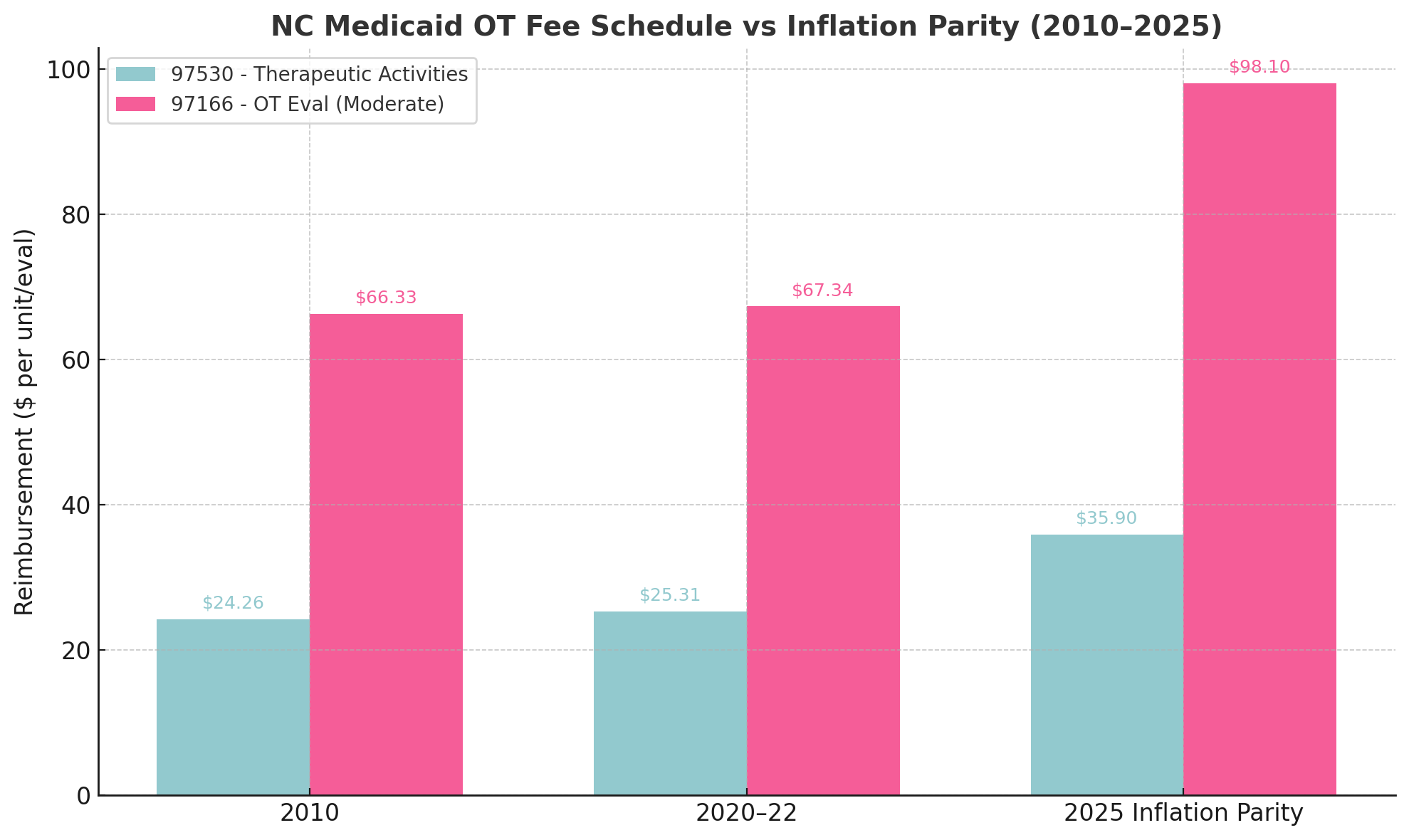
    We also know the rate trajectory: no meaningful rate increase in nearly 20 years, followed by a proposed 3 percent reduction on October 1, 2025 (subsequently paused), on a fee schedule that currently reimburses pediatric OT at approximately $24 per 15-minute unit.

    The contact-hour ratio

    A child in a typical 30-hour-per-week ABA program receives approximately 1,500 hours of clinical contact per year.

    • ABA vs. OT alone at full pediatric annual ceiling: 1,500 hours vs. 78 hours, roughly 19 to 1
    • ABA vs. OT + PT + SLP combined at full ceiling: 1,500 hours vs. 234 hours, roughly 6.4 to 1

    Even when a child is authorized for the maximum of all three rehabilitation disciplines, ABA delivers more than six times the clinical contact hours.

    The dollar math, per child, per year

    At the current NC Medicaid pediatric OT rate of approximately $24 per 15-minute unit:

    • OT alone at full annual ceiling (312 units): approximately $7,488 per child per year
    • OT + PT + SLP combined at full annual ceiling, generous estimate: approximately $22,000 to $25,000 per child per year
    • ABA average per child per year: $37,600

    ABA spending per child is roughly five times higher than OT alone at full annual ceiling, and approximately 50 to 70 percent higher than all three rehab disciplines combined at maximum authorization. And that comparison assumes the rehab disciplines are billing at ceiling, which most are not, because the ceiling is rarely authorized in full.

    The state’s own policy paper acknowledges, in Action 7:

    if an assessment finds a member should receive occupational therapy, that may necessitate a lower intensity of RB-BHT based upon a child’s capacity to tolerate and benefit from the intensity of hours across all interventions.

    The state is, in essence, conceding that the current spending pattern is wrong: ABA is being prescribed at intensities that displace OT and the other rehab disciplines, even when an assessment would indicate the child needs OT instead of, or in addition to, ABA.


    The credentialing gap

    Who actually delivers most ABA service hours? Not Board Certified Behavior Analysts. The vast majority of direct-service ABA hours are delivered by Registered Behavior Technicians.

    Registered Behavior Technician (RBT)

    Under Behavior Analyst Certification Board requirements:

    • High school diploma or equivalent
    • Age 18 or older
    • Pass a criminal background check
    • Complete a 40-hour training course, frequently completed online in two to three weeks, often as part of employer onboarding
    • 3 of those 40 hours must cover ethics
    • Pass a brief competency assessment with a BCBA
    • Pass an 85-question multiple-choice exam
    • Total out-of-pocket cost can be under $100
    • No college coursework required
    • No clinical fieldwork required
    • No state healthcare licensure required in most states, including North Carolina

    NC DHHS’s policy paper notes that NC does not currently require even the national BACB Registered Behavior Technician certification. The state is now proposing to require it.

    Board Certified Behavior Analyst (BCBA)

    The supervising clinician credential is more substantial: master’s degree, 1,500 to 2,000 hours of supervised fieldwork, board examination, ongoing continuing education. The BCBA is the responsible clinical decision-maker but typically is not the person delivering the direct service hours.

    Certified Occupational Therapy Assistant (COTA)

    For comparison, here is what an OT Assistant brings to the same room:

    • Associate’s degree from an ACOTE-accredited OTA program, typically two years of college coursework
    • Roughly 16 weeks of full-time Level II fieldwork, approximately 640 hours
    • Pass the NBCOT national board examination for COTAs
    • State licensure
    • Continuing education units required for license renewal
    • Practices under the supervision of a licensed OT, with supervision frequency and scope defined by state law
    • Adherence to the AOTA Code of Ethics and state practice act

    Occupational Therapist (OT)

    • Master’s or doctoral degree from an ACOTE-accredited program
    • Roughly 24 weeks of full-time Level II fieldwork, approximately 960 hours
    • Pass the NBCOT national board examination for OTs
    • State licensure in every state, including NC
    • 15 CEUs per renewal cycle in NC
    • Adherence to the AOTA Code of Ethics and state practice act

    The contrast that matters

    A COTA, who works under the supervision of a licensed OT, has roughly (at minimum) two full years of accredited college coursework, plus 16 weeks of supervised clinical fieldwork, plus a national board examination, plus state healthcare licensure, plus ongoing CEUs before delivering hands-on pediatric therapy.

    An RBT, who is the frontline provider for the majority of ABA service hours, has 40 hours of training, no college, no fieldwork, and no state healthcare licensure before delivering hands-on pediatric therapy. In NC, even the basic national BACB credential is not currently required.

    A licensed OT or COTA delivering one hour of NC Medicaid pediatric OT, after two years (COTA) or six-plus years (OT) of accredited coursework and clinical training, is reimbursed at a rate that has not risen in nearly 20 years. An RBT, after 40 hours of training, is part of a payment stream that grew 425 percent in four years and is projected to consume $639 million in 2026.


    Where the money is: ABA companies absorbing OT and SLP

    A growing trend in pediatric autism services: ABA companies are hiring licensed OTs and SLPs to deliver services within an ABA-organized clinical model. Some practitioners arrive through dual-credentialing pathways, since the BACB has removed degree-field restrictions for BCBA candidates and made the OT-to-BCBA and SLP-to-BCBA transitions more accessible. Others are simply employed to deliver OT or SLP services in-house, but inside a treatment plan organized around 25 to 40 hours per week of ABA.

    The result is a structural absorption. Licensed clinicians from the rehab disciplines are increasingly delivering care inside ABA-organized clinical models, rather than the other way around. The treatment plan is built around behavior analysis. OT and SLP become supplemental services to a primary ABA intervention. The child’s calendar, the care coordination, and the parent-facing narrative all center on ABA, with OT and SLP positioned as add-ons.

    This is the inverse of what NC DHHS’s own policy paper recommends: whole-person care planning with the full continuum of evidence-based services coordinated by a licensed professional, and ABA used at the intensity clinically necessary rather than as the organizing modality.


    Where ABA infringes on OT scope

    AOTA’s scope of practice statement, and every state OT practice act, anchors the profession around occupation: ADLs and IADLs, feeding, eating, and swallowing, sensory processing and integration, fine and visual-motor skills, play, school participation, and meaningful engagement in life situations across home, community, and school contexts.

    ABA programs are increasingly billing into the same scope of practice:

    • Feeding therapy delivered by RBTs using food chaining, escape extinction, and behavioral feeding protocols. This is historically OT and SLP scope, and the AOTA Practice Guideline on Feeding, Eating, and Swallowing explicitly identifies OTs as uniquely positioned to evaluate and treat these problems due to the integration of sensory, motor, and contextual factors.
    • Toileting programs framed as ABA “ADL training,” delivered without the underlying motor planning, sensory processing, interoception, and developmental readiness assessment that an OT brings.
    • Fine motor skill acquisition including handwriting, scissor use, and utensil use, delivered as discrete trial training without consideration of grasp development, in-hand manipulation, bilateral coordination, or visual-motor integration.
    • Sensory regulation strategies delivered without sensory integration training, often using behavioral reinforcement paradigms that can be in direct conflict with sensory-based clinical reasoning.
    • Play skill development delivered as discrete trial training, which structurally cannot replicate the developmental work of OT-facilitated play.

    The clinical risk is not theoretical. A child whose food refusal is being treated as behavioral by an RBT-delivered feeding program may have undiagnosed dysphagia, retained primitive reflexes, oral-motor apraxia, sensory-based food aversion, or ARFID. A child whose handwriting is being treated as a compliance issue may have undiagnosed developmental coordination disorder or visual-perceptual deficits. A child whose self-injury is being addressed through behavioral extinction may have undiagnosed sensory dysregulation or pain.

    The ICF-CY framework makes this distinction clear. ABA’s traditional outcome targets sit at the body function and activity level. OT’s outcome targets sit at the participation level, in life situations across home, school, and community. These are not interchangeable, and a child whose week is dominated by body-function and activity-level work in a controlled 1:1 setting may never get to the participation work that produces durable, generalizable change.


    The 6 to 8 hour per day problem

    The clinical issue with high-dose ABA prescribing is not only what is being delivered in the ABA hours. It is what is not being delivered in the hours that are no longer available.

    Many ABA prescriptions land at 25 to 40 hours per week, often 6 to 8 hours per day for preschool-age children. A 4-year-old in ABA from 8 AM to 2 PM has no calendar space for OT, no calendar space for SLP, no calendar space for PT, no time for naturalistic family interaction, no time for play with neurotypical peers, no time for developmentally normative experiences in community settings.

    The insurance and Medicaid reality compounds this. When ABA absorbs the weekly therapy budget or the child’s tolerance for therapy, OT, SLP, and PT get cut to 30-minute sessions once a week, or eliminated entirely. The 156-unit ceiling becomes irrelevant when the child has no time on the calendar for those sessions. Families are often not offered a coordinated multidisciplinary plan. They are referred to ABA, that becomes the plan, and the other disciplines are reduced to consultation or eliminated.

    Pediatric OT is grounded in distributed practice across natural contexts. A child needs OT-informed strategies woven through meals at the family table, transitions in real classrooms, play with siblings, and community outings. That cannot happen when the child is in a 1:1 controlled clinical environment for the majority of waking hours.


    What pediatric OT must do

    The defensive and offensive responses converge. Four priorities.

    Build the outcome-measurement infrastructure. Pediatric OT cannot continue documenting in narrative paragraphs and informal goal-attainment scaling and expect to survive the audit climate that is coming, much less to win fee-schedule advocacy battles. The profession needs interval-level outcome measurement using Rasch-grounded instruments that produce defensible, change-detectable, statistically interpretable data, mapped to ICF-CY participation-level outcomes. The next generation of pediatric OT documentation needs to look more like a psychometric report and less like a clinical narrative.

    Pursue fee-schedule advocacy with data, not testimony. Personal testimony from therapists about the cost of doing business has not moved the needle in nearly 20 years. What might: a defensible return-on-therapy-investment dataset showing measurable participation-level change per dollar across OT, PT, SLP, and ABA. The legislature responded to the NC ABA spending data because it was specific, quantified, and contrasted. The same approach applied to pediatric OT, PT, and SLP would be hard to ignore.

    Defend scope of practice at the state level. State licensure boards, Medicaid coverage policy, and state Practice Acts are the legal mechanisms that define what discipline can deliver what service. Feeding, sensory integration, motor skill training, ADL training, and play-based participation work are OT and SLP scope under every relevant statute and AOTA practice document. Documenting scope encroachment in writing, with case examples, and submitting it to state licensure boards and Medicaid clinical coverage policy reviewers is how scope gets defended.

    Build the coordinated multidisciplinary alternative and educate referral sources. The strongest argument is not “ABA is bad.” It is that a coordinated OT plus SLP plus parent-coaching plus targeted developmental behavioral support model, delivered at 6 to 10 total hours per week with measurable participation-level outcomes, produces durable change at a fraction of the cost and a fraction of the developmental opportunity cost. Most pediatricians refer to ABA reflexively after an autism diagnosis. Most parents have never been offered a clear picture of what each pediatric therapy discipline addresses or what an integrated plan looks like. Parent-facing and pediatrician-facing materials, grounded in the ICF-CY framework, would shift the referral conversation.


    Closing

    This is not a turf war. It is a question about who is qualified to deliver what, what the actual evidence supports, what a child’s developmental window is best used for, and who is being paid what when public money is involved.

    Medicaid exists under a statutory framework of medical necessity. That framework is supposed to mean something. When a discipline whose direct-service workforce is not credentialed as medical professionals receives a 15 percent rate increase, expands 425 percent in four years, and consumes a projected $639 million in a single state budget year, while disciplines whose direct-service workforce is licensed as medical professionals receive no rate increase for nearly 20 years and then a proposed 3 percent reduction, the framework is not being applied consistently. NC DHHS’s own policy paper, released for community feedback in 2025, acknowledges the structural problems: providers diagnosing autism and then referring patients to their own services, treatment plans that are not individualized, ABA being used as primary treatment when less intensive evidence-based therapies would be more appropriate, and audits in Indiana, Wisconsin, and Massachusetts already documenting tens of millions in improper payments.

    ABA at moderate intensity, delivered by well-supervised clinicians, can be a useful component of an autism intervention plan for some children. ABA at 30 to 40 hours per week, delivered primarily by paraprofessionals with 40 hours of training, on a payment trajectory that has grown 425 percent in four years, while one provider collects $64.91 million from NC Medicaid in a single year, is a different conversation.

    The NC fraud investigations, the proposed Policy 8F revisions, and the NC DHHS policy paper are an opening. Clinical Coverage Policy is being rewritten in real time. The legislature is paying attention. The Attorney General is paying attention. Audit infrastructure is being built that will, predictably, expand to OT, PT, and SLP next.

    Pediatric OT has the evidence base, the credentialing rigor, the participation-focused framework, the developmental science, and the ICF-CY anchor. What it needs is the measurement infrastructure to translate clinical work into payer-defensible data, the advocacy coordination to get that data in front of policymakers, and the practice-owner discipline to make documentation audit-ready before the audit arrives.

    The pediatric population this profession serves deserves better than what the current system is delivering. So does the profession.

    Stephanie, OT/L, MS
    Head Wizard


    References and primary sources

    NC-specific policy documents

    1. NC DHHS. (2025). Ensuring Person-Centered Care for Children with Autism Spectrum Disorder in the NC Medicaid Program. https://medicaid.ncdhhs.gov/policy-paper-ensuring-person-centered-care-children-autism-spectrum-disorder-nc-medicaid-program/open
    2. NC Medicaid. Clinical Coverage Policy 8F: Research-Based Behavioral Health Treatment for Autism Spectrum Disorder. https://medicaid.ncdhhs.gov/8f-research-based-behavioral-health-treatment-rb-bht-autism-spectrum-disorder-asd/download?attachment=
    3. NC Medicaid. Outpatient Specialized Therapy Services (Clinical Coverage Policy 10A). https://medicaid.ncdhhs.gov/providers/programs-and-services/medical/outpatient-specialized-therapy-services
    4. NC Medicaid. October 1, 2025 NC Medicaid Rate Reduction Questions and Answers. https://medicaid.ncdhhs.gov/providers/claims-and-billing/october-1-2025-nc-medicaid-rate-reduction-questions-and-answers

    Investigative reporting

    1. Baxley, J. (2026, April 27). NC moves to rein in soaring autism therapy costs amid fraud concerns. North Carolina Health News. https://www.northcarolinahealthnews.org/2026/04/27/autism-therapy-costs/
    2. Private Equity Stakeholder Project. (2026). Private Equity in ABA: Report on the Behavioral Health Industry. https://pestakeholder.org/wp-content/uploads/2026/04/PESP_Report_PE-in-ABA_2026.pdf

    Federal audits and prosecutions

    1. U.S. Department of Health and Human Services Office of Inspector General. (2024). Indiana Made at Least $56 Million in Improper Fee-for-Service Medicaid Payments for Applied Behavior Analysis Provided to Children Diagnosed with Autism. https://oig.hhs.gov/documents/audit/10123/A-09-22-02002.pdf
    2. U.S. Department of Health and Human Services Office of Inspector General. (2025). Wisconsin Made at Least $18.5 Million in Improper Fee-For-Service Medicaid Payments for Applied Behavior Analysis Provided to Children Diagnosed With Autism. https://oig.hhs.gov/documents/audit/10497/A-06-23-01002.pdf
    3. Office of the Inspector General Massachusetts. (2024). MassHealth and Health Safety Net: 2024 Annual Report. https://www.mass.gov/doc/masshealths-applied-behavior-analysis-program-service-providers-oig-2024-annual-report/download
    4. U.S. Attorney’s Office, District of Minnesota. First Defendant Charged in Autism Fraud Scheme. https://www.justice.gov/usao-mn/pr/first-defendant-charged-autism-fraud-scheme-0

    National evidence reviews and DoD reports

    1. National Academies of Sciences, Engineering, and Medicine. (2025). The Comprehensive Autism Care Demonstration: Solutions for Military Families. Washington, DC: National Academies Press. https://www.nationalacademies.org/our-work/independent-analysis-of-department-of-defenses-comprehensive-autism-care-demonstration-program
    2. U.S. Department of Defense. (2020). Annual Report on Autism Care Demonstration Program. https://health.mil/Reference-Center/Congressional-Testimonies/2020/06/25/Annual-Report-on-Autism-Care-Demonstration-Program
    3. Lovaas, O. I. (1987). Behavioral treatment and normal educational and intellectual functioning in young autistic children. Journal of Consulting and Clinical Psychology, 55(1), 3–9.

    Credentialing bodies and scope of practice

    1. Behavior Analyst Certification Board. Registered Behavior Technician (RBT) Requirements. https://www.bacb.com/rbt/
    2. American Occupational Therapy Association. Occupational Therapy Scope of Practice. https://www.aota.org/practice/practice-essentials/scope-of-practice
    3. American Occupational Therapy Association. Code of Ethics. https://www.aota.org/practice/practice-essentials/ethicsstandardsa/code-of-ethics
    4. National Board for Certification in Occupational Therapy. https://www.nbcot.org/
    5. Accreditation Council for Occupational Therapy Education. https://acoteonline.org/
    6. AOTA Practice Guideline. The Practice of Occupational Therapy in Feeding, Eating, and Swallowing. https://www.oregon.gov/otlb/Documents/The%20Practice%20of%20Occupational%20Therapy%20in%20Feeding,%20Eating,%20and%20Swallowing.pdf

    Federal Medicaid framework

    1. Centers for Medicare & Medicaid Services. Early and Periodic Screening, Diagnostic, and Treatment (EPSDT). https://www.medicaid.gov/medicaid/benefits/early-and-periodic-screening-diagnostic-and-treatment

    Trauma and outcomes literature on ABA (referenced in evidence section)

    1. Kupferstein, H. (2018). Evidence of increased PTSD symptoms in autistics exposed to applied behavior analysis. Advances in Autism, 4(1), 19–29. Note: Journal issued an Expression of Concern in 2025. Findings should be cited with methodological caveats.
    2. Leaf, J. B., Ross, R. K., Cihon, J. H., & Weiss, M. J. (2018). Evaluating Kupferstein’s claims of the relationship of behavioral intervention to PTSS for individuals with autism. Advances in Autism, 4(3), 122–129.
    3. McGill, O., & Robinson, A. (2021). “Recalling hidden harms”: Autistic experiences of childhood applied behavioural analysis (ABA). Advances in Autism, 7(4), 269–282.
  • Value-Based Care Is Coming for Therapy Practices

    Value-Based Care Is Coming for Therapy Practices

    Value-Based Care Is Coming for Therapy. Here’s What It Means — and Why Some Practices Are Already Ready.


    A significant document landed this week. AOTA, APTA, and ASHA — the three largest therapy professional associations in the country — released a joint publication: Value-Based Care for Therapy: A Provider’s Guide. When three associations that rarely agree on anything publish something together, it is worth paying attention to.

    This post is for occupational therapists, physical therapists, speech-language pathologists, mental health professionals, and the practice owners who employ them. Whether you work in a clinic, a school, a hospital, or private practice — this shift is coming for you.


    What Is Value-Based Care, and Why Does It Matter Now?

    For decades, therapy has been paid under a fee-for-service model. You provide a service, you bill a code, you get paid. Volume drives revenue. The system rewards doing more, not necessarily achieving more.

    Value-based care flips that model. Under VBC, payment is tied to the value of care delivered, meaning the outcomes achieved relative to the cost of achieving them. Payers want evidence that patients improved, that care was efficient, and that therapy dollars produced measurable functional change.

    CMS has stated formally that by 2030, all Medicare plans and most Medicaid plans will include accountability for quality and total cost of care.

    And for anyone thinking this is only a Medicare issue, it is not. Commercial payers historically follow Medicare and Medicaid, typically within two to five years of federal adoption.Plans such as United Healthcare, Blue Cross, Aetna, United, and Cigna watch the federal model and build similar requirements into their own contracts. This is an incoming reality for your entire payer mix, regardless of the population you serve.


    What Will Payers Actually Require — and How Will They Get the Data?

    This is where it gets specific, and where most therapy providers are underprepared.

    Under value-based care contracts, payers will not rely solely on claims data. They will aggregate multiple data streams to generate a risk-adjusted performance score for each provider. That score determines reimbursement rates, bonus eligibility, penalty exposure, and increasingly — prior authorization requirements.

    The data sources payers will draw from include diagnostic codes, functional status scores at evaluation and discharge, episode length, caregiver and patient-reported outcome measures, and social determinants of health. Together, these paint a picture of who your patients are, how complex their needs are, and whether your billed intervention produced meaningful change.

    The risk adjustment piece deserves particular attention. Payers use a system called Hierarchical Condition Categories (HCC) to score the complexity of a provider’s caseload. The formula looks at diagnosis codes to predict how difficult and costly a patient’s care should be. The intent is fairness: a practice treating children with complex medical histories and significant functional deficits should not be benchmarked against a practice treating mild developmental delays.

    But here is the problem. If your documentation does not accurately capture patient complexity (ex: if your evaluations are narrative rather than structured, if diagnoses are under coded, if functional deficits are described rather than measured by metrics) the HCC formula underestimates your caseload. Your practice looks like it is treating simpler patients than it is. Your performance scores suffer. Your reimbursement suffers. Thorough, structured clinical documentation is no longer just professional best practice. It is financial protection.

    There is also a significant upside for high performers. Practices that consistently demonstrate measurable functional outcomes under VBC contracts will be rewarded with reduced prior authorization burdens. For any therapist who has spent hours writing auth appeals, had sessions denied mid-episode, or watched a child lose momentum because a payer delayed approval, that outcome is worth working toward.


    What the VBC Guide Specifically Calls For

    The joint guide outlines several infrastructure requirements for therapy providers preparing for value-based care. Here are the most consequential:

    1. Objective, structured outcome measurement. The guide is explicit: quality measures require scoreable, comparable data — not narrative notes. Payers need to be able to extract, aggregate, and benchmark outcome data across providers. Narrative documentation cannot be benchmarked. Structured, scored data can.

    2. Patient and caregiver-reported outcome measures. The guide specifically highlights the growing importance of capturing outcomes from the patient and family perspective — not just the clinician’s clinical observation. These measures capture health status, function, and quality of life as experienced by the people receiving care. They are becoming a required component of VBC quality scoring.

    3. Longitudinal data across the full episode of care. A snapshot evaluation is not sufficient. Payers need a before and after — baseline functional status, mid-episode progress, and discharge outcome. Without that full-episode arc, there is no way to calculate the value of the intervention.

    4. ICF framework for data exchange. The guide references the International Classification of Functioning, Disability, and Health — ICF — as the standard framework for exchanging functional status data across providers, settings, and payers. Providers whose documentation is built on ICF structure are already speaking the language payers are building their systems around.

    5. Social determinants of health. VBC models are increasingly required to capture nonmedical factors that influence outcomes — housing stability, transportation access, food security, economic stability. These factors affect therapy outcomes and will be factored into risk adjustment models.


    Why Most EMRs and EHRs Will Leave Practices Exposed

    Here is the uncomfortable truth: most electronic medical records and electronic health records were built for fee-for-service. They are fundamentally accounting systems — designed to track what was billed, scheduled, and coded. They do an adequate job of supporting claims submission. They do almost nothing to capture clinical intelligence.

    When value-based care contracts begin requiring structured outcome data, longitudinal functional measures, and caregiver-reported scores, practices running on a standard EMR will have nothing meaningful to submit. The documentation exists, but it is locked in narrative notes that cannot be extracted, scored, or benchmarked. That is a serious vulnerability.

    The practices that will navigate this transition well are the ones that have been capturing structured, measurable clinical data all along — not because a payer required it, but because good clinical practice demanded it.


    If You Are Using OT Wizard, You Are Already Ahead

    OT Wizard was not built to react to value-based care. It was built on the clinical and psychometric principles that value-based care is now catching up to.

    Here is how OT Wizard already delivers what the VBC guide calls for:

    1. Objective functional outcome data. OT Wizard generates structured documentation grounded in the ICF framework — the exact standard the VBC guide identifies for measuring and exchanging outcome data. Every evaluation produces metrics on each domain, subdomain and a composite score, structured functional data, not just narrative description.

    2. Caregiver and patient-reported measures. OT Wizard captures scored questionnaires from caregivers and families at baseline, mid-therapy, and discharge. That full-episode caregiver perspective is built into the platform workflow — not an add-on, not a separate form. It is the data payers will specifically look for.

    3. Longitudinal data across the episode of care. Because OT Wizard tracks from intake through discharge, pre and post functional data is built into every case. That full-episode arc is what payers need to calculate a risk-adjusted performance score accurately and fairly.

    This is what separates a clinical intelligence system from an accounting system. OT Wizard is not just recording what happened. It is measuring what changed.


    What Is Coming Next

    We are not stopping here. We are currently building Billing Wizard feature — a dedicated insurance billing feature integrated directly into OT Wizard. Your clinical outcome data and your claims will live in the same system. As value-based care contracts begin requiring outcome data alongside claims submissions, that integration will matter enormously.

    And not too far away, we will develop Therapy Wizard — an expansion that will bring this same clinical intelligence foundation to speech-language therapy, physical therapy, and mental health. One platform, one outcome framework, built for the full therapy team. Because value-based care does not silo disciplines — and neither should your documentation infrastructure.


    The Bottom Line

    The payment landscape is changing and the timeline is real. The practices that will thrive are not the ones that scramble to retrofit their documentation after the contracts change but are the ones that already have the infrastructure in place.

    If you are an OT, PT, SLP, or mental health professional asking what you can do right now: document with precision, capture complexity, measure function at intake and discharge, and make sure your platform is built to produce structured data… not just notes.

    If you are a practice owner: this is an infrastructure conversation, not just a clinical one. The system you are documenting in today will determine whether you can compete for value-based contracts tomorrow.

    The field is changing. OT Wizard was already here.


  • What We Document vs. What We Actually Need to Know

    What We Document vs. What We Actually Need to Know

    Clinical Takeaways | O.T. Wizard Research Series, Part 1

    By Stephanie Seymore Wick, MSOT, OT/L | Founder and Clinical Architect, O.T. Wizard


    Most pediatric OTs are excellent documenters. We write thorough evaluations, set meaningful goals, and log every session. The paper trail is solid. So why is it so hard to answer the one question that matters most?

    Is this working and if so, how much?

    Not “are we doing the right things?” Not “is this child making progress in a general sense?” The specific question: is this child changing, how fast, and is that fast enough?

    That question turns out to be surprisingly hard to answer with the tools most of us are using.

    The Snapshot Problem

    A standardized evaluation gives you a score at one point in time. A re-evaluation gives you another score. You compare the two and write a narrative about what changed. That is snapshot documentation, and it is useful. It tells you where a child started and where they landed.

    What it does not tell you is anything about the line between those two points.

    When did the change happen? Was progress steady, or did the child plateau for two months and then accelerate? Did a specific intervention approach produce better outcomes than others? Did an attendance gap create a measurable dip? Did the child actually cross a key functional threshold six weeks before the re-evaluation was even scheduled?

    Without structured session-level data linked to domain scores, you simply cannot see any of that. You have two dots. You do not have a trajectory.

    Why This Shows Up Differently in Medical vs. School Settings

    In a medical outpatient practice, the moment this gap becomes visible is usually an authorization request. You are being asked to justify continued services and the strongest argument is quantitative: here is where the child started, here is the rate at which they are improving, and here is where they are projected to land by the end of this period. Without RTI data, you fall back on clinical narrative. Narrative is defensible. It is not the same as a slope.

    In school-based practice, the moment arrives at the IEP table. You are sitting with a team that includes a parent, a classroom teacher, a special educator, and an administrator. They are deciding whether OT services should continue, increase, or be exited. The OT who arrives with a performance slope and a comparison to natural developmental growth is a different professional presence than the one who arrives with quarterly progress notes. Both care about the child. Only one has data that can change a decision.

    Exit recommendations are especially difficult without RTI data. Recommending that a child be exited from OT services is a clinical and ethical judgment call. With measurement data showing that the child has reached functional independence or participation and is maintaining gains without direct support, it becomes a defensible milestone. Without that data, it is an opinion.

    The Plateau Conversation

    Every pediatric OT has been here. A child who was making visible progress has leveled off. The parent is worried. The payer is skeptical. The school team is questioning whether to continue services.

    The problem is that a plateau looks the same on paper whether it is stagnation or consolidation. A child consolidating a new skill at a lower level of support may show no numerical gain for several sessions. That is not failure. It is a normal part of skill acquisition. But without session-level performance data, you cannot show anyone the difference. You can only explain it.

    With structured data, you can show the team exactly when the plateau began, what changed in the child’s routine or support structure around that time, and whether similar plateaus have resolved in this child’s history. That changes the conversation from “we think this is temporary” to “here is what the data shows.”

    What Parents Are Actually Asking

    When a parent asks whether therapy is working, the most honest answer most therapists can give without RTI infrastructure is a clinical impression. That impression may be completely accurate. But it is not the same as showing a parent a graph of their child’s performance over twenty sessions and saying: here is where he started, here is the rate at which he is moving, and here is what we project by the end of this period.

    For school-based OTs, the parent question arrives at the IEP table, in front of an entire team. The quality of your data shapes what parents understand, what they advocate for, and what they accept when the team recommends a service change. That matters.

    The Practical Distinction

    Documentation and measurement are not the same system. They are not competing systems either. They serve different purposes.

    Documentation records what happened, establishes compliance, and communicates clinical reasoning. Measurement tracks rate of change, identifies what conditions produce better performance, and determines whether progress is sufficient.

    Most EHRs were built for the first column. Very few were built for the second. The gap between them is not a failure of clinical intent. It is a gap in infrastructure. EMR’s are typically built by people who are interesting in billing insurance and keeping accounting records. They are not clinical intelligence systems.

    One Finding Worth Noting

    When the O.T. Wizard re-evaluation data was examined, Participation and Executive Functioning showed flat longitudinal profiles compared to the large gains seen in VMI, ADL, and fine motor domains. The initial interpretation might be that OT did not improve those areas. But there is another possibility worth taking seriously: the first evaluation rating in those domains may not have captured authentic baseline behavior. Children often present their best behavior when meeting a new therapist in a structured evaluation setting. By re-evaluation, the novelty has worn off. The rating that looks flat may simply be more accurate.

    That is a question that would not have surfaced without measurement data. It has real implications for how we interpret initial evaluation scores in observation-dependent domains. It is the kind of question that data raises and documentation alone cannot.

    A Few Things to Reflect On

    At re-evaluation, how do you determine the rate at which a child progressed? Can you identify which sessions produced the most meaningful gains? Can you show a parent the slope of improvement over an authorization period? Can you distinguish a true plateau from a reduction in required support?

    If those questions are hard to answer with your current system, the infrastructure gap is real, and it is worth thinking about.

    Parts 2 through 4 of this series will move from problem framing to evidence to practice, including composite clinical vignettes, full dataset patterns, and what RTI infrastructure looks like in day-to-day clinical workflow.


    Disclosures: The author is the Founder and Clinical Architect of O.T. Wizard and has a financial interest in the platform. All data referenced is de-identified clinical data collected through the O.T. Wizard software platform in routine practice.

    About O.T. Wizard: O.T. Wizard is a clinical intelligence system for pediatric occupational therapy professionals. The platform evaluates performance across twelve domains including visual-motor integration, fine motor skills, gross motor skills, praxis, visual perception, executive functioning, activities of daily living, and participation. For more information, visit otwizard.com.


  • How to Write OT Evaluation Reports That Insurance Actually Approves

    How to Write OT Evaluation Reports That Insurance Actually Approves

    You spent 90 minutes conducting a thorough pediatric occupational therapy evaluation. Another hour and a half writing a detailed report. You submitted it to insurance with confidence. Then the denial letter arrives: “Medical necessity not established.”

    Sound familiar? You’re not alone. Insurance denials for occupational therapy evaluations are frustrating, time-consuming, and costly. But here’s the good news: most denials happen because of how the report is written, not whether the child actually needs services.

    Let’s fix that.

    The Insurance Approval Formula: Medical Necessity + Functional Impact + Skilled Service

    Insurance companies don’t deny services because they don’t believe children need help. They deny because the documentation doesn’t prove three critical elements:

    1. Medical Necessity: A documented diagnosis or condition that requires intervention
    2. Functional Impact: Clear evidence that the condition limits daily functioning
    3. Skilled Service: Proof that an occupational therapist’s expertise is required (not just supervision or general instruction)

    Your evaluation report must explicitly address all three. If even one is missing or unclear, expect a denial.

    What Insurance Reviewers Actually Read (And What They Skip)

    Here’s a secret: the person reviewing your report spends about 90 seconds on it. They’re not reading every word. They’re scanning for specific elements. Most likely they are being read by their AI Bot.

    What they look for:

    • Diagnosis codes (ICD-10)
    • Functional limitations stated explicitly
    • Objective test scores and measurements
    • Clear statement of skilled OT intervention need
    • Specific safety concerns (if applicable)

    What they skip:

    • Long narrative descriptions
    • Clinical observations without data
    • Educational jargon (IEP goals, classroom performance)
    • Developmental history (unless directly relevant)

    The takeaway: Front-load your report with the information they need. Don’t bury medical necessity in paragraph seven.

    The 7 Elements Every Insurance-Approved Report Contains

    1. Clear Diagnosis at the Top

    Wrong:
    “Johnny is a 5-year-old male referred for fine motor concerns.”

    Right:
    “Johnny is a 5-year-old male with a diagnosis of Developmental Coordination Disorder (ICD-10: F82) referred for occupational therapy evaluation secondary to significant fine motor and visual-motor integration deficits impacting activities of daily living.”

    Notice the difference? The second version includes diagnosis code, specific deficit areas, and functional impact in the first sentence.

    2. Functional Limitations Stated Explicitly

    Insurance doesn’t care that a child scores in the 5th percentile on the Beery VMI. They care that this score means the child cannot complete age appropriate functional activities, such as independently buttoning their shirt, writing their name legibly, or using utensils safely.

    For every test score, include the “so what” statement:

    Test Result: Visual perception skills measured at 2 standard deviations below age expectations on TVPS-4 (standard score: 70).

    Functional Impact: This significant deficit prevents Johnny from independently locating items in his backpack, finding his desk in the classroom, and distinguishing similar letters (b/d, p/q) during early literacy tasks. Parent reports Johnny requires maximum assistance with dressing due to inability to orient clothing correctly.

    3. Objective Measurements and Standardized Scores

    Clinical observations alone don’t prove medical necessity. You need numbers.

    Include :

    • Standardized test scores with percentiles or standard scores (like Peabody, Beery VMI) or Rasch-calibrated /Criterion referenced assessments (like PEDI-CAT, OT Wizard, or HELP)
    • Timed performance measures (e.g., “completed pegboard task in 145 seconds; age expectation is 45 seconds”)
    • Quantifiable observations (e.g., “grasped pencil in fisted grasp 100% of observed writing attempts”)
    • Measurable functional deficits (e.g., “required 4 verbal cues and 2 physical assists to don shirt”)

    Research shows: Reports with comprehensive domain coverage across 8 areas (ADL, Executive Functioning, Fine Motor, Gross Motor, Visual Perception, Visual Motor Integration, Praxis, and Participation) have significantly higher approval rates because they provide objective evidence across multiple functional areas.

    4. Medical Necessity Language (Not Educational Language)

    If you primarily treat in schools, but are a medical based provider (meaning you aren’t an IEP provider), this is critical. Insurance reviewers don’t understand educational terminology.

    Educational Language (Don’t Use):
    “Johnny requires OT services to access his educational curriculum and participate in classroom activities per his IEP.”

    Medical Necessity Language (Use This):
    “Johnny requires skilled occupational therapy intervention to develop functional grasp patterns, visual-motor integration skills, and bilateral coordination necessary for age-appropriate self-care tasks including dressing, feeding, and personal hygiene.”

    Key Differences:

    EducationalMedical
    StudentPatient
    Classroom participationFunctional independence
    IEP goalsTreatment goals
    Educational benefitMedical necessity
    School activitiesActivities of daily living

    5. Safety Concerns (When Present)

    Safety issues fast-track approvals. If present, state them clearly.

    Examples:

    “Child demonstrates impulsive behavior and poor body awareness, resulting in 3 falls from playground equipment in past month per parent report. Requires skilled OT intervention to develop safety awareness and motor planning.”

    “Significant oral-motor deficits result in choking incidents during meals 2-3 times per week. Skilled feeding therapy required to establish safe swallowing patterns.”

    “Decreased proximal stability and postural control result in frequent loss of balance during mobility, with 2 documented injuries requiring medical attention in past 6 months.”

    6. Why Skilled OT is Required (Not Just Caregiver Training)

    Insurance will deny if they think a parent or teacher could provide the same intervention. You must prove why your clinical expertise is necessary.

    Not Skilled:
    “Child will benefit from practice with buttoning and zipping.”

    Skilled Service:
    “Child requires skilled occupational therapy to analyze specific motor planning deficits preventing successful fastener manipulation, develop individualized strategies to compensate for bilateral coordination limitations, and systematically grade activity complexity while addressing underlying sensory processing difficulties that interfere with tactile discrimination necessary for fastener manipulation.”

    See the difference? The second version demonstrates clinical reasoning, assessment expertise, and therapeutic skill that cannot be provided by non-therapists.

    7. Concrete Frequency and Duration Recommendations

    Vague recommendations get denied. Be specific.

    Too Vague:
    “Recommend outpatient OT services.”

    Specific and Justified:
    “Patient requires skilled occupational therapy 2x/week for 8 weeks (16 sessions) to address bilateral coordination deficits, visual-motor integration delays, and ADL skill development. Frequency based on severity of deficits (2+ standard deviations below age expectations across 4 domains) and need for motor learning repetition to establish new movement patterns. Re-evaluation recommended after 8-week intervention period to assess progress and determine ongoing needs.”

    Common Denial Reasons and How to Avoid Them

    Denial Reason #1: “Diagnosis not covered”

    Prevention: Check the insurance company’s covered diagnosis list before evaluating. If the primary diagnosis isn’t covered, lead with a secondary diagnosis that is covered but still supports the need for OT.

    Example: Autism (F84.0) might not be covered for outpatient OT, but Developmental Coordination Disorder (F82) or Sensory Processing Disorder coded as Other Specified Developmental Disorders (F88) often are.

    Denial Reason #2: “Educational, not medical”

    Prevention: Even if you’re a school-based therapist, emphasize ADL and home function impacts, not just classroom performance.

    Include:

    • Dressing difficulties
    • Feeding/utensil use challenges
    • Hygiene and self-care limitations
    • Safety concerns at home
    • Community participation barriers

    Denial Reason #3: “Not medically necessary”

    Prevention: State explicitly in your report: “Skilled occupational therapy is medically necessary to address [diagnosis] which significantly impacts patient’s ability to [specific functional tasks], resulting in dependence on caregivers for age-appropriate self-care and safety concerns during daily activities.”

    Denial Reason #4: “Insufficient objective data”

    Prevention: Use standardized assessments. Clinical observations alone aren’t enough. Data from 404 evaluations shows that assessments with zero missing data and comprehensive domain coverage provide the objective evidence insurance requires.

    The Report Structure Insurance Prefers

    Section 1: Demographics and Diagnosis (Top of Page)

    • Name, DOB, date of evaluation
    • Primary diagnosis with ICD-10 code
    • Referring physician

    Section 2: Medical Necessity Statement (First Paragraph) One clear paragraph stating diagnosis, functional limitations, and why skilled OT is required.

    Section 3: Assessment Results

    • Standardized test scores
    • Functional performance observations
    • Quantifiable data
    • Each with functional impact statement

    Section 4: Clinical Impressions

    • Summary of findings
    • How deficits impact daily function
    • Safety concerns (if applicable)

    Section 5: Recommendations

    • Specific frequency (2x/week)
    • Specific duration (8 weeks)
    • Justification for both
    • Explicit medical necessity statement

    Keep it concise: 2-3 pages maximum. Remember, they spend 90 seconds reading it.

    Real Example: Before and After

    Before (Gets Denied):

    “Johnny is a pleasant 5-year-old boy who was referred for OT evaluation. He has difficulty with handwriting and gets frustrated during fine motor tasks at school. During testing, Johnny had trouble copying shapes and his pencil grasp looked immature. He would benefit from OT to work on these skills. Recommend weekly OT.”

    Problems: No diagnosis code, no standardized scores, educational focus, vague recommendations, no medical necessity statement.

    After (Gets Approved):

    “Johnny is a 5-year-old male with Developmental Coordination Disorder (F82) referred for occupational therapy evaluation secondary to significant visual-motor and fine motor deficits impacting activities of daily living and self-care independence.

    Assessment Results:

    • Beery VMI: Standard Score 75 (5th percentile, 1.67 SD below mean)
    • O.T. Wizard: Composite 550/1000, ADL 50/100, Fine Motor 72/100, Gross Motor 42/100, Sequencing Praxis 27/100, Visual Motor Integration 72/100
    • Functional grasp assessment: Fisted grasp pattern 90% of observed attempts

    Functional Impact: Visual-motor integration and fine motor deficits prevent Johnny from independently managing fasteners (buttons, zippers, snaps), requiring maximum assistance for dressing. Unable to use utensils safely, resulting in frequent spills and parent reports of choking incidents 1-2x weekly. Cannot complete age-appropriate self-care tasks including tooth brushing and hair combing without hand-over-hand assistance.

    Medical Necessity: Johnny requires skilled occupational therapy to develop functional grasp patterns, bilateral coordination, sequencing praxis, gross motor, and visual-motor integration skills necessary for age-appropriate self-care independence. Deficits 2 standard deviations below age expectations indicate significant impairment requiring therapeutic intervention. Safety concerns related to feeding and frequent falls during mobility necessitate skilled assessment and intervention.

    Recommendations: Skilled occupational therapy 2x/week for 12 weeks to address bilateral coordination, visual-motor integration, and ADL skill development. Frequency based on severity of deficits and need for repetition to establish motor learning. Re-evaluation after 12 weeks to assess progress.”

    Why it works: Diagnosis code in first sentence, standardized scores with functional impact, medical necessity explicitly stated, safety concerns noted, specific recommendations with justification.

    Special Considerations for Different Settings

    School-Based Therapists Seeking Medical Insurance Coverage

    You can write reports that work for both IEP teams and insurance, but you need two versions:

    IEP Version: Focus on educational impact and access to curriculum
    Insurance Version: Same data, different framing focused on ADL and medical necessity

    Pro Tip: Complete your evaluation once, but generate two reports with different emphasis. Your assessment data doesn’t change, just how you present it.

    Outpatient Clinic Therapists

    You have an advantage because you’re already documenting medical necessity. Just ensure you’re:

    • Using covered diagnosis codes
    • Quantifying functional limitations
    • Stating skilled service needs explicitly
    • Providing specific frequency/duration with rationale

    Early Intervention Providers

    Insurance approval for 0-3 age range requires extra emphasis on:

    • Developmental delay severity (how far behind age expectations)
    • Impact on parent-child interaction
    • Safety concerns
    • Risk of further delay without intervention

    The Bottom Line

    Insurance approval isn’t about luck. It’s about documentation. Every denied evaluation report is missing at least one of these elements:

    ✓ Diagnosis code in first paragraph
    ✓ Standardized assessment scores
    ✓ Functional impact statements for every deficit area
    ✓ Medical necessity language (not educational)
    ✓ Explicit statement of why skilled OT is required
    ✓ Specific frequency and duration with justification
    ✓ Safety concerns (when applicable)

    Master these seven elements, and your approval rate will skyrocket.

    Stop spending hours appealing denials. Write it right the first time.

    Streamline Insurance-Compliant Documentation

    Writing insurance-approved reports doesn’t have to take hours. OT Wizard generates comprehensive evaluation reports with all required elements automatically included: diagnosis codes, standardized scores across 8 domains, functional impact statements, and medical necessity /educational eligibility. Choose medical or educational report tone with one click. Stop rewriting reports for insurance appeals.

    Learn more about automated insurance-compliant reporting →

  • Low insurance reimbursement and evidence based practice data

    Low insurance reimbursement and evidence based practice data

    If you are a USA based occupational therapy practitioner, you likely already know that its been YEARS since insurance companies have increased our fee schedule. A fee schedule is the contractural arrangement in which occupational therapy is reimbursed by insurance companies. Medicare is the main player and their fee schedules set precedent for Medicaid and commercial insurance payers.

    I can really only speak to North Carolina Medicaid since its the only state I’ve ever billed insurance, but I’m guessing this may feel like other states.

    North Carolina Medicaid Hasn’t Kept Up: What OT Codes Pay vs. What It Costs (2010 → today)

    North Carolina moved to managed care in 2021, but most outpatient OT clinics still feel like we’re billing 2008 in a 2025 economy. The fee schedule tells the story.

    The receipts (NC Medicaid / NCTracks)

    • Therapeutic activities (97530):
      • $24.26 per 15-min unit in 2010 (non-facility). NC Medicaid
      • $25.31 per 15-min unit in 2020–2022 (non-facility). NC Medicaid
      • Net change: about +$1.05 in 12 years (nominal).
    • OT evaluation
      • 97003 (legacy): $66.33 in 2010. NC Medicaid
      • 97166 (moderate): $67.34 in 2020–2022. NC Medicaid
      • Net change: +$1.01 (nominal)

    Context: NC Medicaid went live with managed care July 1, 2021. Plans use contracted rates with rate-floor fee schedules in their contracts, but the published fee schedules still function as the practical baseline most clinics see.

    What those dollars mean in 2025

    • Inflation since 2010 ≈ 48%. $1 in 2010 needs ≈ $1.48 today to break even. In 2013 Dollars
    • Translate that to therapy:
      • 97530 would need to be ≈ $36 today just to equal its $24.26 value in 2010 (24.26 × 1.48 ≈ 35.9). NC Medicaid’s $25.31 is ~30% short of inflation parity. (Math shown; inflation source above.) NC Medicaid+1In 2013 Dollars
      • 97166 would need to be ≈ $98 today to equal $66.33 in 2010 (66.33 × 1.48 ≈ 98.1). Current $67.34 is ~31% under inflation parity. NC Medicaid+1In 2013 Dollars
    • Since 1998, general prices have nearly doubled (+98%). So if OT rates were flat or near-flat in the 2000s, the real value of an OT unit has been cut roughly in half. In 2013 Dollars

    “Real-life” clinic math (why it feels impossible)

    • Typical medical practice overhead runs 60–70% of revenue (rent, admin, software, insurance, billing, supplies, taxes). 99mgmt.com
    • OT wages: BLS shows $98,340 U.S. median (May 2024); NC average ≈ $94,580. That’s about $45–$47/hour before benefits. Bureau of Labor StatisticsO*NET OnLine

    Put it together for Medicaid 97530 at $25.31/unit (four units/hour = $101.24/hour gross):

    • Overhead (60–70%): $60–$71/hour out the door. 99mgmt.com
    • Leftover to pay your OT’s wage+benefits: $30–$41/hour — below typical fully-loaded clinician cost. Net: you lose money unless productivity is pushed past what’s clinically sane, or non-Medicaid payers subsidize Medicaid.

    For comparison, Medicare pays roughly mid-$30s per unit for 97530 nationally in 2024 (varies by locality). That’s still tight, but it’s notably higher than NC Medicaid’s ≈$25. empoweremr.comCenters for Medicare & Medicaid Services

    The blue is what the fee schedule IS and the pink is where it should be in order to account for inflation.

    Other providers got raises (and why that matters)

    • Primary care & dental: NC Medicaid raised primary care rates to Medicare levels and dental +10% in recent years to stabilize access. North Carolina Files
    • Behavioral health: In Nov 2023, the state announced “first time in a decade” increases across mental health/SUD/I/DD/TBI. NC DHHSAxios
    • 2025 House budget (proposal): 3% Medicaid increases for several provider groups, including speech-language therapy, optometry, podiatry, etc. (OT wasn’t explicitly listed in that report). North Carolina Health News

    Takeaway: North Carolina is willing to adjust rates when access is at risk — but outpatient OT hasn’t seen commensurate, inflation-aware updates in its core codes.

    Why “managed care” didn’t fix it (yet)

    Managed care adds care-coordination, quality metrics, and the possibility of state-directed payments and rate floors, but it doesn’t magically lift base OT rates. Plans still anchor to state fee baselines unless you negotiate. If OT can prove avoidable costs reduced and functional outcomes improved, you’ve got leverage for above-floor rates.

    How NC OTs Can Advocate (and win) in 2025

    1) Lead with evidence that speaks payer-language

    Metrics that resonate with Medicaid and health plans:

    • Time to functional milestone (e.g., goal attainment within X visits).
    • Care intensity → outcome curve (doses/units vs. gains).
    • Episode cost and reduced downstream spend (fewer ED visits, less specialty escalation, shorter LOS after surgery).
    • School/IEP-relevant gains (attendance, participation) for kids covered under EPSDT — align to policy language. NC Medicaid

    2) Use O.T. Wizard as a longitudinal outcomes engine

    This is where OT Wizard can be your differentiator:

    • Standardize eval templates to capture baseline participation & function (COPM/GOAL-ATTAINMENT or your preferred measure) and auto-score session-level progress.
    • Track cohorts across diagnosis, age, frequency, modality (clinic/home/tele).
    • Auto-generate quarterly payer dashboards: time-to-goal, units per successful episode, no-show rate impact, discharge status, re-referral rates.
    • Export plan-ready PDFs/CSVs tagging CPT mix (97530, 97110, 97535, 97166)outcomecost per episode.
    • Build pre/post comparisons on commonly denied diagnoses to show where 15–30% more units drive measurable functional gains (and where they don’t).

    3) Make a targeted rate ask

    • For NC Medicaid Direct: reference the documented stagnation — 97530 and evals are ~30% below inflation parity from 2010. Ask for an inflation alignment step-up (e.g., $36/unit target for 97530). NC Medicaid+1In 2013 Dollars
    • For Managed Care plans: request above-floor OT carve-outs or value-based add-ons using your outcomes package. Point to recent BH & primary care raises as precedent that the state is willing to move rates when access is at stake. NC DHHSAxiosNorth Carolina Files

    4) Coalition up

    • Partner with PT & SLP peers and pediatric systems to show waitlists, turnover, and geographic gaps tied to low OT rates.
    • Bring parent/teacher testimonials plus quantified access delays (days to eval; cancellations due to network gaps).
    • Align with legislative interest: point to the 2025 House budget considering rate bumps for other services (ask, “Why not OT?”). North Carolina Health News

    5) Keep the policy receipts handy

    • Cite NC’s managed care launch and rate-floor guidance to show plans have levers; you’re asking them to use those levers for OT. NC Medicaid+1
    • Anchor your “ask” to CPI (BLS) so it’s not an emotional plea; it’s math. In 2013 Dollars

    Bottom line

    • NC Medicaid’s 97530 and OT eval amounts have barely budged nominally since at least 2010; in real dollars, they’ve fallen ~30% versus inflation. NC Medicaid+1In 2013 Dollars
    • The state has shown it will raise rates (primary care, dental, behavioral health) to protect access — OT should be next. North Carolina FilesNC DHHS
    • Use OT Wizard to produce longitudinal outcome evidence and push for inflation-aligned floors (and plan-level add-ons) so clinics can actually hire, retain, and serve. 💕