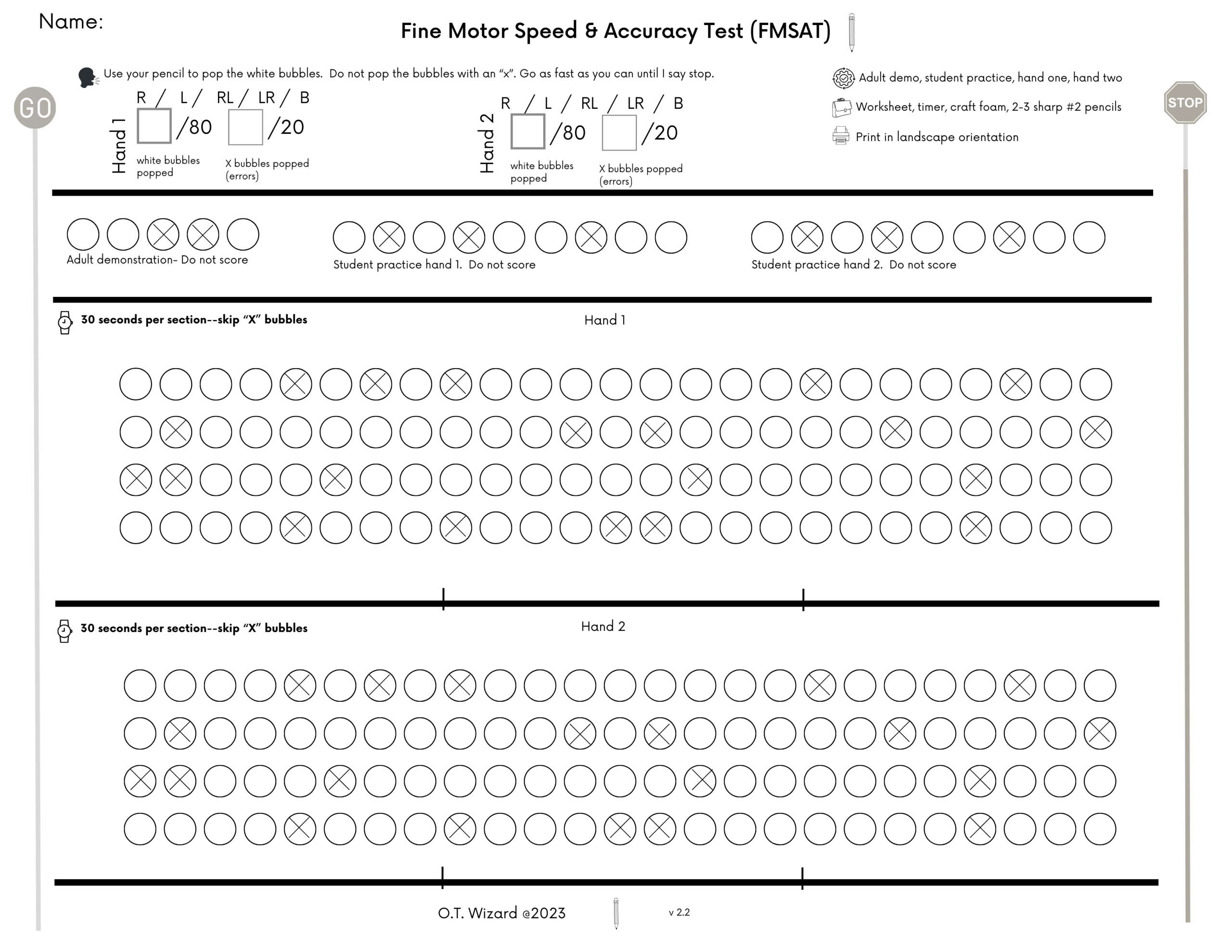
A standardized worksheet with rows of small circles. Thirty seconds per hand. A sharpened pencil. That is the entire assessment.
We call it Fine Motor Speed and Accuracy Test (FMSAT)- because that is where we want the test taker’s attention. But the data is telling us the test is not really about speed at all. It is about which hand the nervous system has committed to, and when, and why some people never fully commit. After more than 1,400 bilateral trials across ages three to seventy-plus, the data is starting to show what this simple task can actually see.
Looking for a Fine Motor Screener
Pediatric and adult OTPs have long needed a brief, standardized, score-based measure that complements clinical observation without replacing it. We built the Fine Motor Speed and Accuracy Test (FMSAT) to fill that gap. But we wanted more than a number. We wanted evidence that the number maps onto the broader clinical picture a skilled clinician already sees.
The correlation picture emerging from our data is that kind of evidence. FMSAT scores are converging with the O.T. Wizard Fine Motor domain score, with related motor domains, and with the overall composite. They are converging with the Fine Motor Participation Rating Scale (FMPRS), our companion clinician observational instrument. And deliberately, we looked outside the O.T. Wizard platform for independent evidence, because self-referential data is not ecological validity.
One number stands out. Ninety-seven percent. That is the rate at which a child’s self-selected first hand on the FMSAT matches the clinician’s independent rating of their grasp hand, captured in the same session. For context, most concurrent validity correlations in pediatric motor assessment literature sit in the .40 to .60 range. A 97% agreement rate between a one-minute task-based score and an independent clinician observation is not ordinary.
O.T. Wizard
O.T. Wizard is a clinical intelligence platform for occupational therapy, built by a working clinician. It is not billing software with clinical documentation bolted on. The architecture runs the other direction. Evaluations produce structured scored data across clinical domains. Plans of care, goals, session measurement, and progress reports compose from that data. The FMSAT is embedded inside the evaluation workflow, which means every FMSAT score sits alongside clinician ratings captured in the same session, by the same clinician. That co-occurrence is what makes this dataset rare and the ecological validity analysis possible.
The FMSAT National Team
Assessment compliance is the quiet killer of norming studies. The FMSAT has mostly solved that problem by accident, because we designed it to be fast, and being fast made it feel like a game. One team member put it this way:
“I find this assessment really easy to administer and the students really like it. I’ve been telling them it’s a game we’re starting with to pop bubbles and they get really excited. One of my students was actually frustrated with me when he didn’t get to go first today LOL.”
The lifespan data is being built by a distributed team of licensed OTPs from school-based and clinic-based settings. Some of our most active therapist researchers to date are: Lauren David, Veronica Sydlowski, Kelly Simiele, Christie LeClair, Meghan Taylor, Jenna Hogan, Kayla Hauck, Chanda Waller, Ronda Horton, Catherine Jones, Meredith Pait, and the full Learning Charms therapy team. The project is IRB-determined as not-human-subjects research (Pearl IRB 2026-0154). A sixty-second administration produces meaningful data on both hands, where Hand One is the test taker’s self-selected first hand and Hand Two is the other.
Combined Lifespan Trends
A developmental trajectory is emerging from the combined data. The gap between Hand One and Hand Two rises through early childhood, peaks in young adulthood, and compresses again in adults sixty and older. One of the patterns that surprised us most is how far that compression goes. In our current data, the Hand One to Hand Two gap in adults in their sixties looks more like the gap in a six-year-old than in a forty-year-old. A one-minute screener appears to be catching the full arc of neuromotor lateralization across the lifespan.
There is a plausible framework for part of this pattern. The HAROLD effect, or Hemispheric Asymmetry Reduction in Older Adults, was first described by Cabeza (2002) and has since been documented in motor performance by Seidler et al. (2010) and Sullivan et al. (2010). The pattern we are seeing in adults sixty and older is consistent with what HAROLD predicts: reduced hemispheric specialization as the brain ages, which would show up on a bilateral motor task as a compressed gap between hands. Our data is early and the sample in this age range is still small. We are not in a position to claim HAROLD replication. We are in a position to say the trend line in our data is pointing where the literature would predict it should point, and we intend to keep collecting.
What It May Be Measuring
The test directs attention toward speed and accuracy. The constructs surfacing in the data are different. Fine motor capability, reflected in the Hand One score. Neuromotor lateralization, reflected in the gap between the two hands. These are separate clinical questions and should not be collapsed into a single number. The X-score, which counts errors on distractor circles the test taker is instructed to skip, appears to capture a third construct entirely: impulse control. That will be its own study.
The Finding That Is Changing How We Build Norms
Left-dominant test takers show about half the asymmetry of right-dominant test takers. We think a lifetime of adapting to right-biased tools, scissors, can openers, computer mice, spiral notebooks, trains the non-dominant hand upward. Whatever the cause, it means the norms we build cannot treat everyone the same way. More to come on that front.
Join the Team
The dataset now spans ages three through seventy-plus, and collection continues. We are specifically seeking OTPs with access to adult populations to join the National Team. We plan to finish the research by mid summer 2026. Contributors are acknowledged by name in the validation work and earn CEUs through the O.T. Wizard platform. If you are interested, reach out: stephanie@learningcharms.com.
Leave a Reply