Tag: laterality

  • 1,480 Trials: Building a Fine Motor Screener OTPs Actually Want to Use

    1,480 Trials: Building a Fine Motor Screener OTPs Actually Want to Use

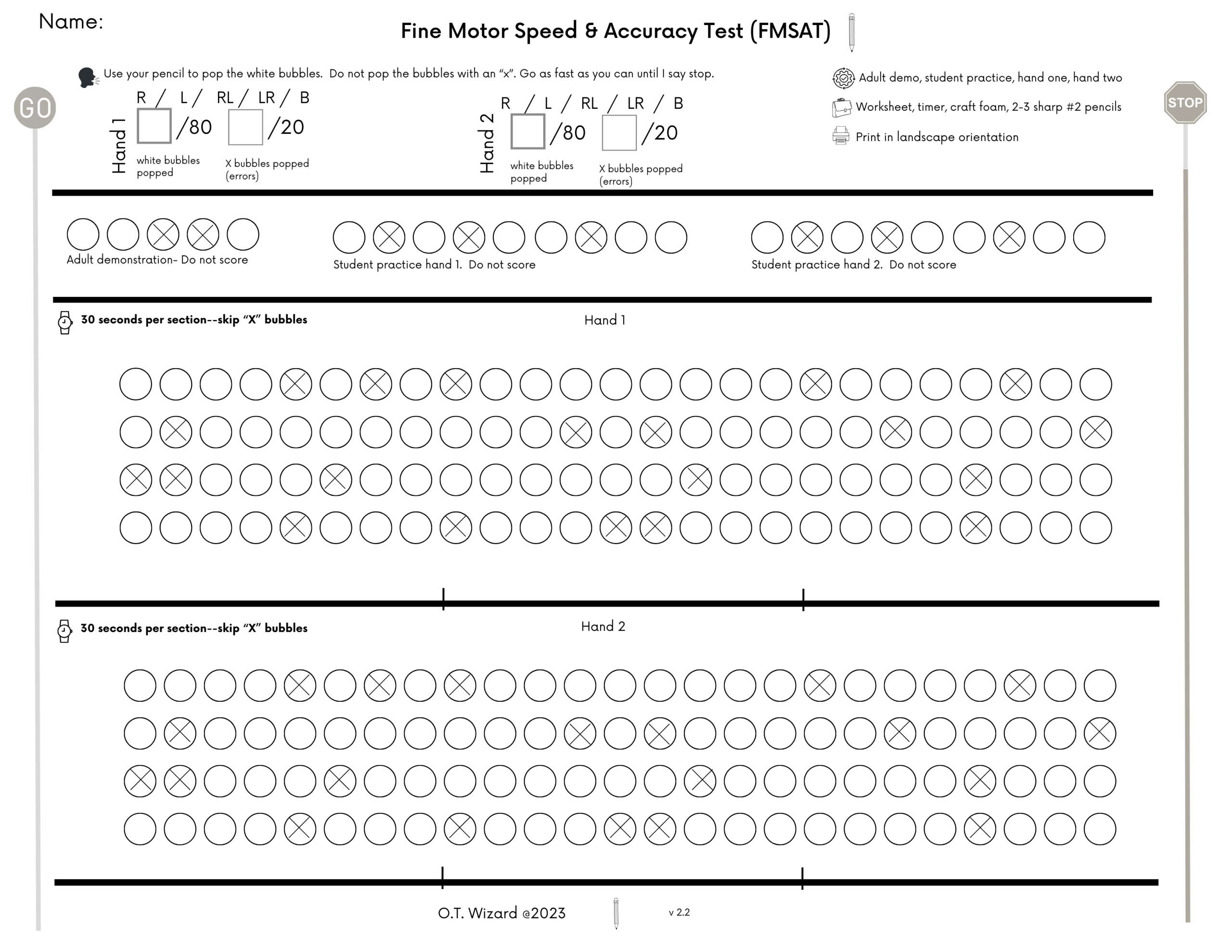
    A standardized worksheet with rows of small circles. Thirty seconds per hand. A sharpened pencil. That is the entire assessment.

    We call it Fine Motor Speed and Accuracy Test (FMSAT)- because that is where we want the test taker’s attention. But the data is telling us the test is not really about speed at all. It is about which hand the nervous system has committed to, and when, and why some people never fully commit. After more than 1,400 bilateral trials across ages three to seventy-plus, the data is starting to show what this simple task can actually see.

    Looking for a Fine Motor Screener

    Pediatric and adult OTPs have long needed a brief, standardized, score-based measure that complements clinical observation without replacing it. We built the Fine Motor Speed and Accuracy Test (FMSAT) to fill that gap. But we wanted more than a number. We wanted evidence that the number maps onto the broader clinical picture a skilled clinician already sees.

    The correlation picture emerging from our data is that kind of evidence. FMSAT scores are converging with the O.T. Wizard Fine Motor domain score, with related motor domains, and with the overall composite. They are converging with the Fine Motor Participation Rating Scale (FMPRS), our companion clinician observational instrument. And deliberately, we looked outside the O.T. Wizard platform for independent evidence, because self-referential data is not ecological validity.

    One number stands out. Ninety-seven percent. That is the rate at which a child’s self-selected first hand on the FMSAT matches the clinician’s independent rating of their grasp hand, captured in the same session. For context, most concurrent validity correlations in pediatric motor assessment literature sit in the .40 to .60 range. A 97% agreement rate between a one-minute task-based score and an independent clinician observation is not ordinary.

    O.T. Wizard

    O.T. Wizard is a clinical intelligence platform for occupational therapy, built by a working clinician. It is not billing software with clinical documentation bolted on. The architecture runs the other direction. Evaluations produce structured scored data across clinical domains. Plans of care, goals, session measurement, and progress reports compose from that data. The FMSAT is embedded inside the evaluation workflow, which means every FMSAT score sits alongside clinician ratings captured in the same session, by the same clinician. That co-occurrence is what makes this dataset rare and the ecological validity analysis possible.

    The FMSAT National Team

    Assessment compliance is the quiet killer of norming studies. The FMSAT has mostly solved that problem by accident, because we designed it to be fast, and being fast made it feel like a game. One team member put it this way:

    “I find this assessment really easy to administer and the students really like it. I’ve been telling them it’s a game we’re starting with to pop bubbles and they get really excited. One of my students was actually frustrated with me when he didn’t get to go first today LOL.”

    The lifespan data is being built by a distributed team of licensed OTPs from school-based and clinic-based settings. Some of our most active therapist researchers to date are: Lauren David, Veronica Sydlowski, Kelly Simiele, Christie LeClair, Meghan Taylor, Jenna Hogan, Kayla Hauck, Chanda Waller, Ronda Horton, Catherine Jones, Meredith Pait, and the full Learning Charms therapy team. The project is IRB-determined as not-human-subjects research (Pearl IRB 2026-0154). A sixty-second administration produces meaningful data on both hands, where Hand One is the test taker’s self-selected first hand and Hand Two is the other.

    Combined Lifespan Trends

    A developmental trajectory is emerging from the combined data. The gap between Hand One and Hand Two rises through early childhood, peaks in young adulthood, and compresses again in adults sixty and older. One of the patterns that surprised us most is how far that compression goes. In our current data, the Hand One to Hand Two gap in adults in their sixties looks more like the gap in a six-year-old than in a forty-year-old. A one-minute screener appears to be catching the full arc of neuromotor lateralization across the lifespan.

    There is a plausible framework for part of this pattern. The HAROLD effect, or Hemispheric Asymmetry Reduction in Older Adults, was first described by Cabeza (2002) and has since been documented in motor performance by Seidler et al. (2010) and Sullivan et al. (2010). The pattern we are seeing in adults sixty and older is consistent with what HAROLD predicts: reduced hemispheric specialization as the brain ages, which would show up on a bilateral motor task as a compressed gap between hands. Our data is early and the sample in this age range is still small. We are not in a position to claim HAROLD replication. We are in a position to say the trend line in our data is pointing where the literature would predict it should point, and we intend to keep collecting.

    What It May Be Measuring

    The test directs attention toward speed and accuracy. The constructs surfacing in the data are different. Fine motor capability, reflected in the Hand One score. Neuromotor lateralization, reflected in the gap between the two hands. These are separate clinical questions and should not be collapsed into a single number. The X-score, which counts errors on distractor circles the test taker is instructed to skip, appears to capture a third construct entirely: impulse control. That will be its own study.

    The Finding That Is Changing How We Build Norms

    Left-dominant test takers show about half the asymmetry of right-dominant test takers. We think a lifetime of adapting to right-biased tools, scissors, can openers, computer mice, spiral notebooks, trains the non-dominant hand upward. Whatever the cause, it means the norms we build cannot treat everyone the same way. More to come on that front.

    Join the Team

    The dataset now spans ages three through seventy-plus, and collection continues. We are specifically seeking OTPs with access to adult populations to join the National Team. We plan to finish the research by mid summer 2026. Contributors are acknowledged by name in the validation work and earn CEUs through the O.T. Wizard platform. If you are interested, reach out: stephanie@learningcharms.com.



  • Fine Motor Speed and Accuracy (FMSAT) Norming Update

    Fine Motor Speed and Accuracy (FMSAT) Norming Update

    Overview

    This brief summarizes findings from the FMSAT (Fine Motor Speed and Accuracy Test) norming dataset and OTW platform data as of April 12, 2026. It covers three clinically relevant patterns: the lifespan trajectory of bilateral hand performance, the use of the Dominant Hand Advantage as a clinical decision-support tool, and the distinct profile of left-handed children. Each section connects findings to supporting literature.

    Data sources: FMSAT norming study (n=284 valid bilateral pairs, ages 3-65, and OT Wizard platform administrations (n=374 T1 clinical referrals, ages 3:0-5:5). Both datasets use the identical tasks: POP_BUBB_10 (H1, dominant hand) and POP_BUBB_11 (H2, non-dominant hand) raw bubble counts. Direct comparison is valid.

    Early Signal 1: The Lifespan Trajectory of Hand Dominance

    What the early data shows

    Dominant hand output (H1) and the gap between hands both increase steadily from preschool through early adulthood, then show a gradual decline in later decades. The non-dominant hand (H2) also grows, but more slowly, meaning the ratio between them widens as lateralization consolidates.

    The FMSAT captures not just how fast a child can perform a fine motor task, but how much further ahead one hand is relative to the other. That asymmetry is the developmental signature we are tracking.

    Figure 1. Lifespan H1/H2 trajectory. Preschool bands (3:0-5:5) from OTW clinical T1 (n=374). School-age and adult bands from FMSAT norming dataset (n=284). Bar length proportional to score out of 80. OTW bands shown in teal; FMSAT bands in purple.

    What the literature says

    Hand dominance consolidation is a normative developmental expectation. Most children show consistent hand preference by age 3 to 4, and a clear functional asymmetry in tool use is established by age 5 (Scharoun and Bryden, 2014; Sacrey et al., 2012). The neurodevelopmental substrate is corpus callosum myelination, which progresses through childhood and is substantially complete by approximately age 10 to 12, consistent with the plateau in bilateral asymmetry observed in our school-age data (Lebel and Beaulieu, 2011).

    Children who have not consolidated hand dominance by kindergarten entry demonstrate effortful, inconsistent tool use and reduced handwriting fluency (Dinehart and Manfra, 2013). From an OT practice perspective, unresolved lateralization is a legitimate basis for eligibility justification and a measurable intervention target. What has been missing is a brief, standardized instrument that can quantify lateralization status directly through behavioral performance.

    Key Citations
    Scharoun and Bryden (2014). Hand preference, performance abilities, and hand selection in children. Frontiers in Psychology, 5, 82.  Lateralization consolidates ages 3-4; unresolved dominance associated with motor difficulty. Sacrey et al. (2012). Precocious hand use preference in reach-to-eat behavior in 1- to 5-year-old children. Developmental Psychobiology, 55(8), 902-911.  Early behavioral lateralization. Dinehart and Manfra (2013). Fine motor skills in preschool associated with academic performance in second grade. Early Education and Development, 24(2), 138-161.  Functional outcome: fine motor to academic connection. Lebel and Beaulieu (2011). Longitudinal development of human brain wiring continues from childhood into adulthood. Journal of Neuroscience, 31(30), 10937-10947.  Corpus callosum myelination timeline.

    Early Signal 2: The Dominant Hand Advantage and Hand Selection

    What the early data shows

    When we examine the ratio of dominant to non-dominant hand output across age bands, children with established hand preferences produce approximately 1.5 to 1.6 times more output with their dominant hand. This ratio is consistent from age 7 through adulthood in typical scorers, suggesting it represents a measurable signature of lateralized motor function that has consolidated fully enough to guide clinical decisions.

    1.6xDominant hand advantage in school-age typical scorers~1 in 5Preschool clinical children with near-equal hands at every age band1.0xTied hands — neither has pulled ahead; hand selection may be premature

    Figure 2:

    Figure 2. Lateralization trajectory by age band. Primary metric: Diff% = (H1-H2)/80×100, a fixed-denominator measure that is stable at all ages including preschool. DHAR (H1/H2 median ratio) shown as secondary reference in Signal column. DHAR mean is not used as it is unstable when H2 scores are low (floor effect in age 3 bands). OTW clinical T1 bands in teal; FMSAT norming bands in purple; adult bands in orange. Signal labels: Emerging / Consolidating / Establishing = pediatric lateralization stages; Stable/Peak, HAROLD Effect, Convergence = adult trajectory signals based on callosal aging literature.

    Clinical application: informing the hand-selection conversation

    Handwriting is motor memory. Every time a person writes a letter, the brain strengthens a specific motor pattern in the hand being used. When a child switches hands, they are building two separate motor programs for every letter — and neither program accumulates enough practice to become automatic. Motor learning research is clear: inconsistency prevents automaticity (Schmidt and Lee, 2011). A child who writes with both hands is essentially a beginner with each hand, never progressing to the automatic stage where handwriting becomes effortless.

    For individuals where the ratio is near 1.0 (tied hands), the FMSAT is equally informative: neither hand has pulled ahead yet. In younger children, this may be developmentally expected. In school-age children where dominance should be established, it becomes a meaningful clinical flag. In either case, recommending one hand prematurely may not be appropriate, and a re-evaluation in a few months is often more defensible than committing to one side before the nervous system has made its own lean. For children with developmental coordination difficulties, the clinical stakes are higher still — their motor learning already takes longer than typical, and asking them to build two sets of motor patterns for every letter makes an already difficult task significantly harder (Missiuna et al., 2008).

    What happens in later adulthood

    The early adult data shows the dominant hand advantage holding relatively steady through the 50s — roughly 1.5x — consistent with the hypothesis that decades of occupational repetition continue to maintain dominant-hand specialization even after neurological myelination is complete (Lebel and Beaulieu, 2011). But in the 60+ age band, early data shows the ratio beginning to narrow toward 1.2x, with the non-dominant hand closing the gap.

    This pattern is consistent with what neuroscience research describes as the HAROLD effect — Hemispheric Asymmetry Reduction in Older Adults (Cabeza, 2002). As the corpus callosum undergoes age-related structural atrophy, particularly in its anterior and middle sections, the interhemispheric inhibition that normally keeps the non-dominant motor cortex suppressed during dominant-hand tasks begins to diminish (Seidler, 2010; Sullivan et al., 2010). The result is increased ipsilateral (non-dominant hemisphere) motor activation during even basic unimanual tasks — effectively reducing the behavioral expression of hemispheric specialization. The FMSAT may be capturing this at the behavioral output level: as callosal integrity declines, H2 closes the gap on H1 not because the dominant hand weakens, but because the inhibitory mechanisms that normally constrain the non-dominant hand are less effective.

    This is directional only at current sample sizes — adults over 60 represent n=5 in this dataset. It is, however, a theoretically coherent and clinically interesting signal that warrants investigation as adult data grows.

    What the literature says

    Key Citations
    Packheiser et al. (2023). Elevated levels of mixed-hand preference in dyslexia: Meta-analyses of 68 studies. Neuroscience and Biobehavioral Reviews, 154, 105420.  OR = 1.57 for mixed-handedness in dyslexia across 68 studies, n > 45,000. Highest-priority lateralization-to-learning-disability citation.Packheiser, Papadatou-Pastou, and Ocklenburg (2025). Handedness in mental and neurodevelopmental disorders: A second-order meta-analysis. Psychological Bulletin.  Association specific to early-onset, language-related neurodevelopmental disorders.Rodriguez (2010). Mixed-handedness is linked to mental health problems in children and adolescents. Pediatrics, 125(2), e340-e348.  N = 7,871, Northern Finland Birth Cohort. ADHD-mixed handedness connection.Missiuna et al. (2008). Recognizing and referring children at risk for developmental coordination disorder. Paediatrics and Child Health, 13(7), 565-570.  Motor learning timeline in DCD populations.Cabeza (2002). Hemispheric asymmetry reduction in older adults: the HAROLD model. Psychological Aging, 17(1), 85-100.  Age-related reduction in hemispheric lateralization in both cognitive and motor tasks; foundational model for adult bilateral convergence.Seidler (2010). Functional implications of age differences in motor system connectivity. Frontiers in Systems Neuroscience, 4, 17.  Older adults recruit ipsilateral motor cortex more during dominant-hand tasks; reduced interhemispheric inhibition via callosal atrophy.Sullivan et al. (2010). Quantitative fiber tracking of lateral and interhemispheric white matter systems in normal aging. Neurobiology of Aging, 31, 464-481.  Corpus callosum structural decline in aging correlates with motor processing speed reduction and reduced interhemispheric communication.

    Early Signal 3: Left-Dominant Individuals Show a Different Profile

    What the early data shows

    Left-dominant individuals across all age groups in the FMSAT dataset show a consistently smaller dominant hand advantage than right-handers. Right-dominant individuals average 1.56x; left-dominant individuals average 1.33x. More strikingly, 42% of left-handed participants show near-equal hands (LI less than 10%), compared to 15% of right-handers. Left-handers also show a higher rate of negative gaps — cases where the non-dominant hand actually outperforms the chosen dominant hand.

    GroupMean DHARNon-Dom Hand %% Near-EqualClinical Signal
    Right-Dominant1.56x67% of H115%Standard reference
    Left-Dominant1.33x79% of H142%Separate norms needed
    Inconsistent~1.1x94% of H133%Flag for follow-up

    Figure 3. Dominant Hand Advantage comparison by handedness group. Right-dominant n=238; Left-dominant n=43 (FMSAT norming dataset). Near-equal defined as LI less than 10%.

    Hypothesis: the right-handed world effect

    Our hypothesis is that left-handed individuals grow up navigating a world built primarily for right-hand use. Scissors, desk surfaces, spiral notebooks, zipper pulls, and most classroom tools are designed for right-hand use. The sustained right-hand exposure required to adapt to these tools may keep the non-dominant right hand more capable than it would otherwise be, slowing the natural divergence between hands.

    Whether this represents adaptive bilateral development — a genuine advantage for left-handers who build broader bilateral motor capacity — or a delayed lateralization signal that warrants clinical attention in referred children is a question this dataset will help answer as it grows. Both interpretations have clinical relevance.

    Practical implication: Do not apply right-hand reference values to left-dominant children. A left-handed child with a dominant hand advantage of 1.3x may be completely age-appropriate. That same ratio in a right-handed child of the same age would be a flag. Separate reference values for left-dominant children are required — and are being developed from this dataset.

    What the literature says

    Key Citations
    Goez and Zelnik (2008). Handedness in patients with developmental coordination disorder. Journal of Child Neurology, 23(2), 151-154.  Elevated left-handedness prevalence in DCD populations.Packheiser et al. (2023). Elevated levels of mixed-hand preference in dyslexia.  See Section 2. Also relevant: OR = 1.57 applies specifically to mixed/inconsistent handedness, not left-handedness per se — an important clinical distinction.

    Where We Are Headed

    These findings are pre-normative and drawn from a predominantly clinical sample. They support the theoretical framework of the FMSAT as a lateralization screening tool but do not yet constitute published norms. The norming project is ongoing, and every submission expands the dataset that will make the reference values in this document defensible for clinical and eventual manuscript use.