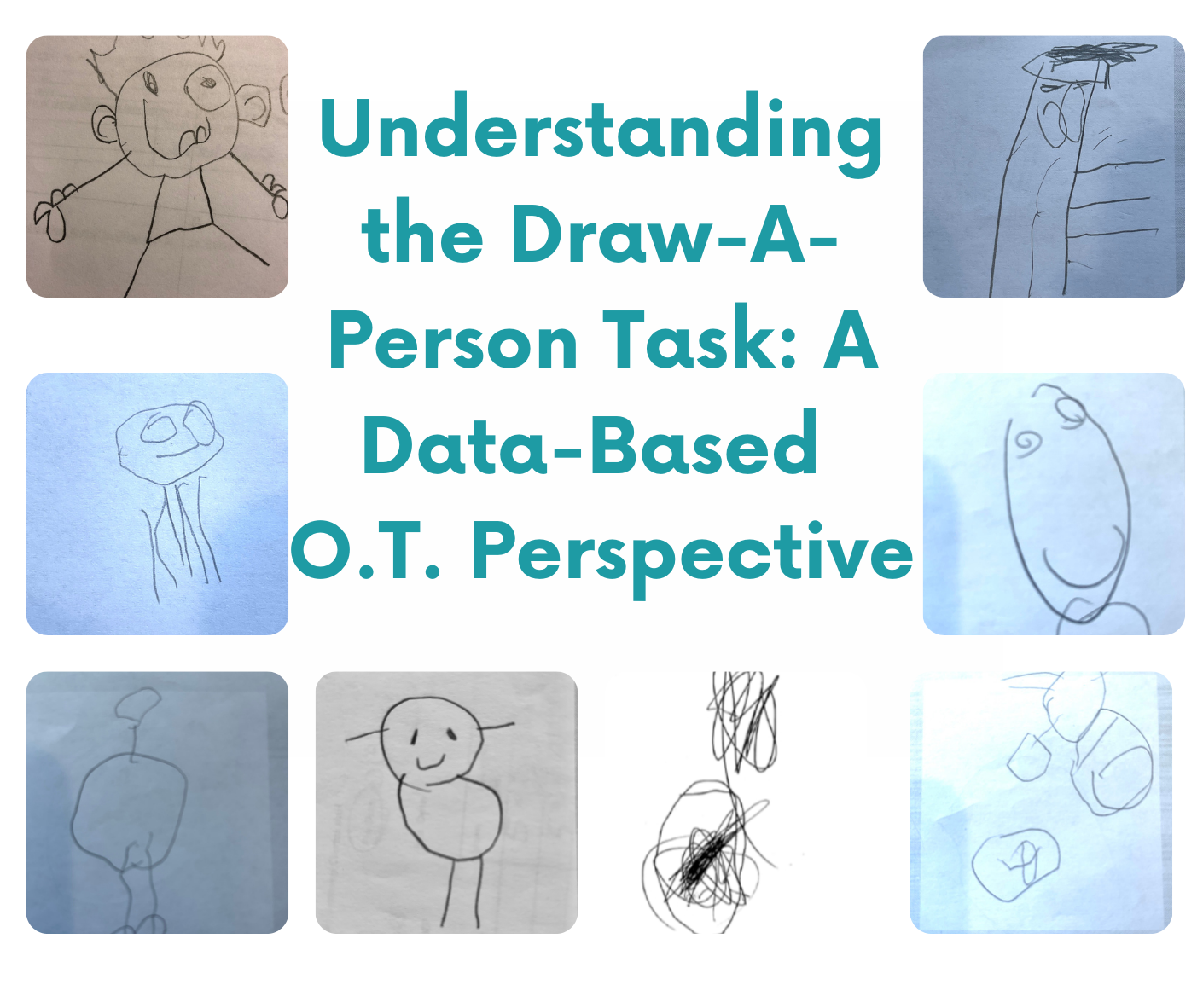
What the Draw-A-Person Task in O.T. Wizard Is Actually Showing Us
A data-based look at the Draw A Person Task in preschool OT evaluations inside O.T. Wizard.
Important context: The data presented here were drawn from preschool children who did not pass an occupational therapy screening and were subsequently evaluated. This sample is not a normative population and should not be interpreted as representative of typically developing preschoolers.
The Draw-A-Person task is a familiar tools in pediatric occupational therapy. It is widely used, information rich, and often referenced in evaluation reports. At the same time, many therapists find it challenging to interpret, especially when scores are low.
Rather than debating the value of Draw-A-Person conceptually, this article looks at how the task behaves in real evaluation data when it is administered consistently across a preschool sample. You may have heard of “The Good Enough Draw A Person” drawing assessment. The O.T. Wizard uses a similar but more simple version.
This analysis is descriptive only. No Rasch or item response modeling has been applied yet.
Sample overview
- Number of evaluations included: 404
- Approximate number of students: 404
- Evaluations with Draw-A-Person data: 401
- Total item-level data points across the evaluation system: 19,062
- Referred clinical sample, not normative population
Draw-A-Person was part of the standard evaluation battery and was administered when the child tolerated the task. Missing responses were excluded rather than scored as zero.
Draw-A-Person scoring rubric
Draw-A-Person was scored using the following criteria:
- Score 0 (0.0): No approximations
- Score 1 (0.2): Approximations emerge
- Score 2 (0.4): Head and parts present but no body
- Score 3 (0.6): Recognizable person with body and at least four body parts
- Score 4 (0.8): Recognizable person with six or more body parts
- Score 5 (1.0): Recognizable person with twelve or more body parts
It is important to note that even a score of 1 reflects emerging representational drawing rather than an absence of skill. The score was converted to a normalized score where a raw score of 5 = normalized score of 1.0 (most credit).
Average Draw-A-Person performance
Across the combined preschool sample:
- Draw-A-Person scores were analyzed using normalized values derived from the scoring rubric. The average normalized score across the preschool sample was 0.38, corresponding to an average rubric level of approximately 1.9. Clinically, this places the average child between “approximations emerge” and “head and parts present but no body.”
- While individual scores varied, this average suggests that most preschoolers in the sample demonstrated emerging representational drawing skills rather than fully recognizable figures
Distribution of Draw-A-Person scores
When responses are mapped directly onto the scoring rubric, the distribution looks like this:
- Score 0, no approximations: 290 children, approximately 72 percent
- Score 1, approximations emerge: 99 children, approximately 25 percent
- Score 2, head and parts without a body: 7 children, approximately 2 percent
- Score 3, recognizable person with body and at least four parts: 4 children, approximately 1 percent
- Score 4, recognizable person with six or more parts: 1 child, less than 1 percent
- Score 5, recognizable person with twelve or more parts: 0 children
This is a heavily floor-weighted distribution.

What this distribution tells us
In this preschool sample, most children did not produce a recognizable person. Nearly three quarters of children showed no recognizable approximations, and only a very small percentage produced a clearly recognizable person with a body.
Draw-A-Person age anchors suggest that by approximately 36 months, children often demonstrate a head with emerging parts, by 48 months a recognizable person with a body and multiple body parts, and by 64 months increasingly detailed human figures. In contrast, the average performance in this referred preschool sample falls between “approximations emerge” and “head and parts present but no body.” This indicates that, as a sample group, these children are demonstrating representational drawing skills that are less mature than would be expected based on age anchors, which is consistent with a population that did not pass an occupational therapy screening rather than a normative sample.
This helps explain why Draw-A-Person often feels like a difficult task for young children and why it frequently stands out in evaluation reports.
Why Draw-A-Person behaves differently than many other tasks
Compared to many visual perceptual, gross motor, or participation-based tasks, Draw-A-Person requires multiple skills to work together at once. These include visual motor integration, visual perception, motor planning, body awareness, fine motor control, and representational thinking.
Because of this high level of integration, Draw-A-Person tends to function as a high-threshold task. It separates children who are beginning to integrate these skills from those who are not yet developmentally ready to do so.
The data supports what many therapists experience clinically. Draw-A-Person is informative, but it should not be interpreted in isolation.
Interpreting Draw-A-Person results responsibly
Based on this data, several points are important for clinical interpretation:
- Low Draw-A-Person scores are common in preschoolers
- Progress from score 0 to score 1 is clinically meaningful
- Scores of 3 or higher represent a small minority of children
- Draw-A-Person should be interpreted alongside visual perceptual, fine motor, praxis, and participation data
Whether the task is developmentally ambitious, exhibits a floor effect, or is a candidate for item misfit will be evaluated during future Rasch analysis. At this stage, the data supports careful, contextual interpretation rather than over-weighting the score.
Why this matters for practice
Most therapists have an intuitive sense that Draw-A-Person is hard for young children. Very few have seen how strongly that intuition is reflected in actual data.
Seeing the full distribution helps recalibrate expectations and supports clearer communication with parents, teachers, and teams. It also reinforces the importance of viewing Draw-A-Person as one piece of a much larger evaluation picture.
As this dataset grows and formal psychometric analysis is completed, these descriptive patterns will be tested and refined. For now, they provide a grounded, data-anchored explanation for why Draw-A-Person feels the way it does in real preschool OT evaluations.
Leave a Reply