If you work with children, you already know that fine motor development is not a single skill. It is a constellation of abilities that unfolds over years, shaped by neurology, practice, environment, and opportunity. What is harder to capture in a clinical setting is the relationship between the two hands, specifically how the dominant and non-dominant hand diverge as laterality develops, and what that divergence tells us about where a child is in their developmental trajectory.
That is exactly what we set out to examine with the FMSAT, the Fine Motor Speed and Accuracy Test. We are currently in the norming phase of the project, collecting data across age groups, classification types, and settings to build a representative dataset. We do not yet have enough responses to publish normative scores, but the early trends are worth discussing because they are clinically interesting and because they reinforce concepts that developmental science has long described but that practicing clinicians rarely have a quick tool to measure.
A Quick Overview of the Task
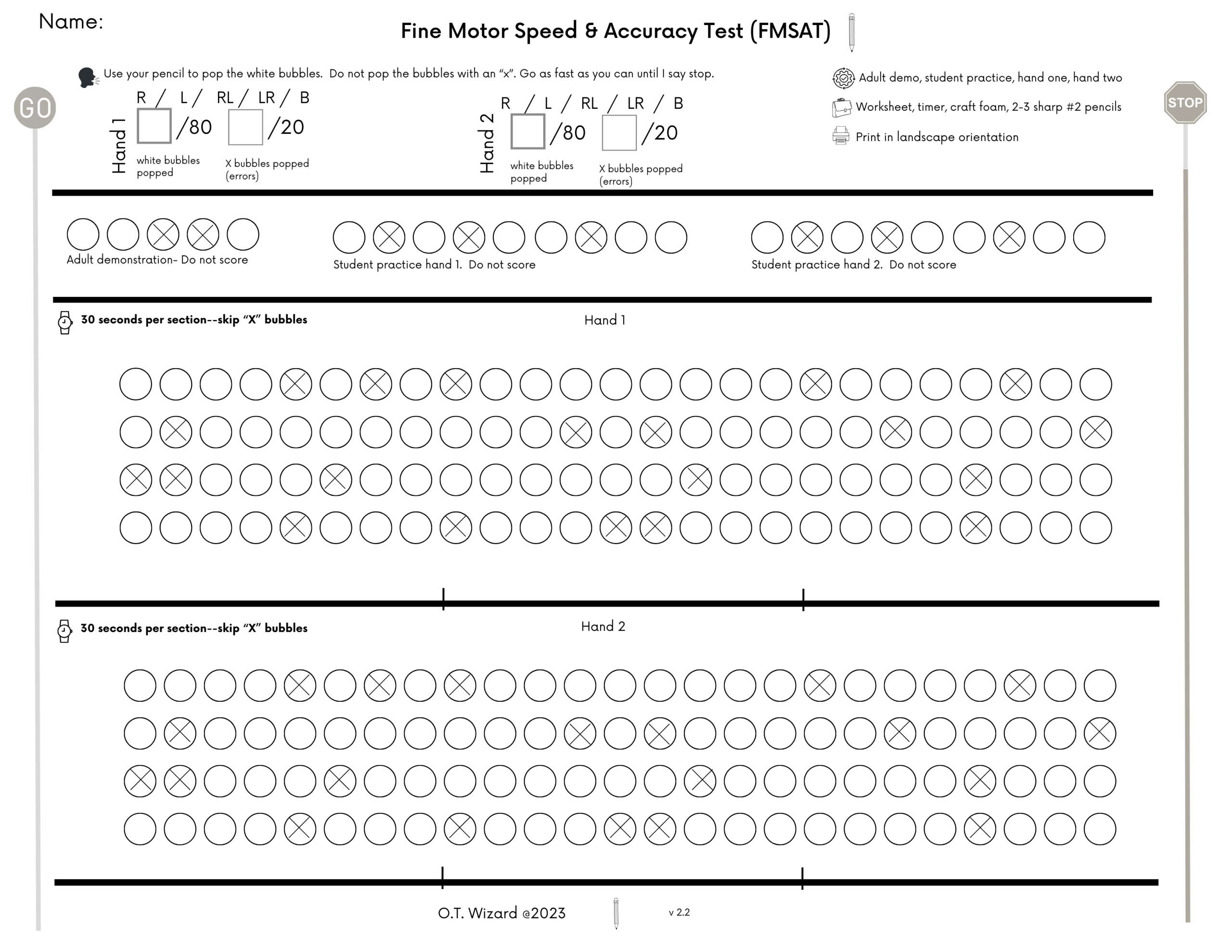
The FMSAT uses a standardized worksheet placed over a piece of craft foam. The test taker uses a sharpened pencil to puncture a hole in each circle on the worksheet, working through the task one hand at a time. Each hand is timed to 30 seconds. The test taker self-selects which hand to use first, which in most cases is the dominant or preferred hand, and then completes the same task with the opposite hand. This produces two independent scores per session, one for each hand, along with observational data about task comprehension and strategy use.
The Laterality Arc Is Showing Up in the Data
One of the most consistent early findings is that younger children score more similarly across both hands, while older children show a progressively larger gap between dominant and non-dominant hand performance. That gap appears to widen through the elementary school years and then stabilize in adulthood.
This is consistent with what developmental theory tells us about laterality. Hand preference is not fully established in most children until somewhere between ages four and six, and functional dominance, meaning the degree to which the dominant hand has pulled ahead in skill, continues to develop well into middle childhood. What the FMSAT appears to be capturing is the functional expression of that process. The two hands are not just different in preference. They become increasingly different in capability as the dominant hand accumulates practiced, automated movement patterns through activities like writing, drawing, and tool use that the non-dominant hand simply does not experience in the same way.
The clinical implication is significant. A large gap between the two hands in a seven or eight year old may reflect healthy lateralization. The same pattern in a ten year old whose non-dominant hand is barely functional as a stabilizer is worth examining more closely. And a very small gap in a six year old may not reflect strong bilateral skills. It may reflect that neither hand has yet established the motor memory that comes with consistent, repeated use of one hand over the other.
Both Hands Are Affected in Children Receiving Services
Children in our dataset who are receiving or have been referred for occupational therapy, physical therapy, speech, or special education services are scoring lower on both hands compared to peers in general education. Not just the non-dominant hand. Both hands.
This finding challenges a framing that sometimes creeps into documentation and goal writing, the idea that a child’s dominant hand is functional and the non-dominant hand is the problem. In our early data, the fine motor challenge appears to be more global. The non-dominant hand is not functioning effectively as a stabilizer or assist hand, which has downstream effects on every two-handed task a child encounters throughout their day. Scissor use, keyboard tasks, object manipulation, self-care, and play all require some degree of coordinated bilateral input. When both hands are underperforming, the functional impact extends well beyond what a handwriting goal alone will address.
Gender Is Not Driving the Scores
Our early data shows almost no difference between male and female performance on the first hand portion of the assessment, less than one tenth of a point difference in mean scores across the full sample. This is worth noting because many fine motor assessments show higher scores for girls, often attributed to earlier neurological maturation, play preferences that favor fine motor practice, or behavioral compliance during structured testing.
The FMSAT’s format may be minimizing some of those influences by presenting a novel, motivating task that does not favor previously practiced skills in the same way that pencil and paper writing tasks do. If the gender parity in our data holds as the sample grows, it would support the use of a single normative table for both sexes and strengthen the argument that the assessment is measuring motor capacity rather than motor experience.
What We Hope This Tool Becomes
The FMSAT was designed to fill a gap that many clinicians feel but struggle to articulate in documentation, the need for a quick, standardized measure of laterality and bilateral fine motor asymmetry that produces defensible, reportable scores. As the dataset grows, we hope to examine whether FMSAT performance correlates with participation in the occupations that matter most to the children we serve, including keeping up with classroom demands, managing self-care and chores at home, and engaging in the play and peer interactions that require confident, coordinated use of both hands.
We are also exploring the potential for the FMSAT to serve as a screener within Multi-Tiered Systems of Support frameworks. A brief validated tool that can flag students who may benefit from Tier 2 or Tier 3 fine motor support before a full evaluation is warranted addresses a real gap in how schools identify children with emerging concerns. Paired with a comprehensive evaluation, it could also serve as a progress monitoring tool, giving clinicians a repeatable, objective measure of whether the gap between the two hands is narrowing over time in response to intervention.
None of this is possible without data. If you are an occupational therapist, COTA, who works with children or adults ages three and up, we invite you to contribute to the norming project. The age bands we need most urgently are the youngest, children ages three through five, where fine motor skill is changing rapidly and even a few months difference in age can reflect meaningfully different developmental profiles. Every submission strengthens the foundation we are building, and the tool we are building is for every child who deserves to have their fine motor profile understood with precision and reported with confidence.
The application form will close at the deadline
Sonnet 4.6
Leave a Reply