A data-based look at executive functioning during OT evaluations
Occupational therapy practitioners often hear some version of the same question:
“They seemed to do fine with you. Why are they struggling so much in class?”
To explore this, we examined therapist-rated Executive Functioning collected during one-on-one OT evaluations with preschoolers. These ratings reflect how children worked with the therapist during the evaluation itself, not how they function in classrooms, group settings, or home environments.
This article focuses on what the data shows and how therapists can interpret these observations responsibly.
Important context about this sample
- Children were referred for OT after failing an occupational therapy screening
- 400+ preschoolers aged 4:0-4:11 , with about equal % of males and females
- This is a clinically referred preschool sample, not a normative group
- Ratings reflect performance during a one-on-one OT evaluation
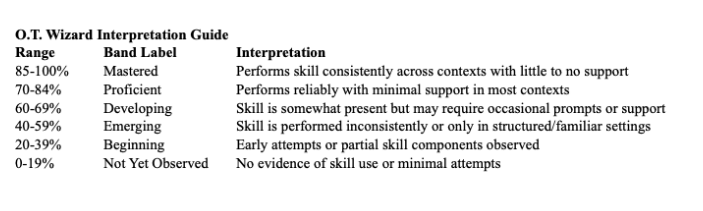
- Work habits were rated using descriptive anchors:
- Not present or Beginning
- Inconsistent or Emerging
- Developing
- Proficient
- Mastered
What the work habit data shows overall
Across all work habit areas, most children in this referred preschool sample were rated in the Developing to Adequate range when working one-on-one with an occupational therapist.
This suggests that many children who struggle in classrooms or group environments are able to participate meaningfully when demands are reduced, expectations are clear, and adult support is individualized.
How children performed across specific work habit areas
Transitions and cooperation
Most children were rated as Developing or Proficient in their ability to transition between activities and cooperate with the therapist during the evaluation.
This indicates that many preschoolers can adapt well to structured tasks when the environment is predictable and supportive, even if transitions are difficult in other settings.
Task initiation and task completion
Task initiation and task completion were commonly rated in the Developing to Proficient range.
Many children required prompting or encouragement to begin tasks, but were generally able to complete them once engaged. This reflects emerging executive functioning skills rather than refusal or lack of effort.
Impulse control and task persistence
Impulse control and task persistence tended to fall in the Developing range.
Children often attempted tasks and remained engaged for short periods but had difficulty sustaining effort across multiple activities. This pattern is typical in preschoolers and becomes more pronounced when task demands increase.
Attention during the evaluation
Attention was the most commonly impacted work habit, even in a one-on-one setting.
Many children were rated between Emerging and Developing for attention. This is an important clinical signal.
When a child struggles to attend during a one-on-one evaluation, they will generally struggle even more in larger, less structured settings such as classrooms, group activities, or busy home environments. Difficulty sustaining attention in a low-demand context often predicts greater challenges when environmental demands increase.
When poor evaluation performance reflects anxiety, not ability
It is also important to acknowledge that not all low work habit ratings reflect true functional ability.
Some preschoolers perform poorly during evaluations because they are:
- Nervous
- Anxious
- Overwhelmed by unfamiliar adults or environments
- Uncertain about expectations
In these cases, performance may underestimate a child’s true skills.
Occupational therapists play a critical role in distinguishing between skill limitations and emotional readiness. Establishing rapport is not optional. It is a clinical necessity.
For some children, establishing rapport may include:
- Spending additional time building trust
- Allowing the child to observe before participating
- Using play or preferred activities to reduce anxiety
- Delaying formal evaluation tasks until the child appears comfortable with the therapist
Evaluation data is only as meaningful as the context in which it is collected.
What this tells us about one-on-one OT evaluations in our 400+ preschool sample
Taken together, these findings suggest:
- Most preschoolers in this referred sample can demonstrate Developing to Adequate work habits in a one-on-one OT evaluation
- Stronger performance in this setting does not negate difficulties in classrooms or group environments
- Attention difficulties observed in one-on-one contexts often signal more significant challenges in larger settings
- Anxiety and lack of rapport can temporarily suppress performance and must be considered during interpretation
Why this matters for interpretation and communication
These data support a critical clinical message:
Performance in a one-on-one OT evaluation reflects what a child can do with individualized support, not what they are expected to manage independently in more complex environments.
When communicating results to families, teachers, and teams, it is essential to clarify the difference between supported performance and real-world participation demands.
Key takeaway for therapists
Based on therapist-rated work habit descriptors:
Most preschoolers in this referred sample demonstrated Developing to Adequate work habits during a one-on-one OT evaluation, while attention and self-regulation remained vulnerable areas, particularly when demands increase or anxiety is present.
This reinforces the importance of careful interpretation, thoughtful rapport building, and contextualized clinical judgment.
📣OTPs : Does this match your experience when evaluating preschoolers? Leave us a comment and let us know.
Leave a Reply