A descriptive snapshot from structured pediatric OT evaluation data (pre-Rasch)
Occupational therapists are trained to interpret evaluations one child at a time. What we rarely get to see is how our observations look in aggregate, across hundreds of evaluations completed using the same structure.
This article summarizes descriptive patterns from the PHI free data of OT Wizard’s preschool OT evaluation data collected since September 2025 using a consistent, structured evaluation framework. The goal is not to draw diagnostic or psychometric conclusions, but to surface real patterns that emerge when data is viewed collectively.
Sample Overview
- Number of evaluations: 404
- Approximate number of students: 404
- Gender: Male: 56%, Female: 44%
- Student Age range (two bands): 4:0-4:11.99
- Primary Language Spoken: English: 90%, Spanish: 9%, Other: 1%
- Primary Diagnosis: F82(Specific Dev Disorder of Motor Function): 95%, Autism: 5%
- Sample is from preschoolers referred to OT evaluation; not a normative population sample
- Total item-level data points: 19,062 normalized responses
Therapist Experience in this dataset
- Average therapist experience: 10.3 years
- Range of therapist experience: 3 to 30 years
Composite Scores (raw, non-Rasch)
- Sample average composite score: 559.7 /1000 (or 55.9%: Emerging Band)
- Observed range: 137 – 873 /1000 (or 13.7%-87.3%)
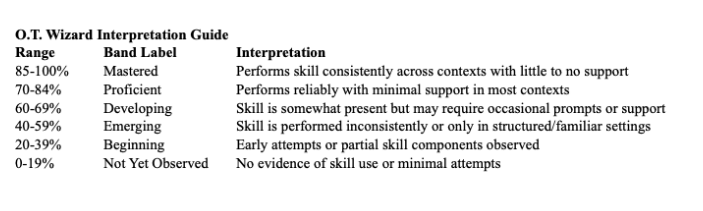
This wide range reflects substantial variability within a relatively narrow age span, reinforcing the importance of looking beyond single summary numbers.
Methods (brief and explicit)
Item-level results are based on normalized scores (0–1) , averaged across evaluations and excluding missing values.
Domain and subdomain scores reflect the mean of available scores only; missing data were not treated as zero.
No Rasch or item-response modeling has been applied at this stage.
Domain Scores (out of 100 points)
Ranked highest → lowest
- Participation, 71
- Executive Functioning, 67
- Visual Perception, 63
- Gross Motor Skills, 63
- Praxis, 55
- Fine Motor Skills. 53
- Activities of Daily Living (ADL), 50
- Visual Motor Integration, 42
Even when age bands are combined, the ordering remains stable. Participation and executive functioning consistently rank highest, while visual motor integration anchors the lower end of the distribution. However, even the highest score (Participation) is at the low range of Proficient.
Subdomain Scores (out of 100 points)
Ranked highest → lowest
- Visual Discrimination, 74
- Visual Figure–Ground, 71
- Participation, 71
- Work Habits (1:1 Therapy Setting), 67
- Trunk Stability, 62
- Hand Use, 62
- Visual Memory, 56
- Bilateral Integration, 61
- Visual Spatial Relations, 55
- Sequencing Praxis, 55
- Dressing, 50
- Scissor Use, 47
- Pre Handwriting ,43
- Speed and Accuracy, 43
- Complex Visual Motor Representation & Integration, 38
Looking at the full ordering — not just the top or bottom — helps clarify where variation clusters across perceptual, motor, and participation-based constructs.
Item-Level Results (out of 100 points)
Normalized scores, ranked highest → lowest
Highest-ranking items
- Match the shape (VP_VD_35), 100
- Find the same shape (VP_VD_40), 100
- What color is each bear? (VP_VD_47), 91
- Dons slip-on shoes (ADL_DRESS_36), 100
- Balance on one foot for 5 seconds (GM_TS_40), 86
- Snip paper in at least one spot (FM_SCIS_6), 82
- Dons simple front-opening coat (ADL_DRESS_33), 87
- Transition performance during evaluation (EF_WORKHAB_5), 81
Several of these items show average normalized scores approaching or reaching 1.0.
Lowest-ranking items
- Sequencing praxis: 4 steps with symbolic action (PR_SP_72)
- Visual Memory (multiple VP_VM items)
- Hop on one foot repeatedly (GM_TS_44)
- Skip for multiple cycles (GM_TS_60, GM_TS_72)
- Draw-A-Person task (VM_DAP)
- Letters written legibly (VM_WANDPK4)
- Pencil bubble popping (FMSAT) – non-dominant hand (POP_BUBB_11)
- Latch a separated zipper (ADL_DRESS_54)
These items consistently fall at the lower end of the distribution across the combined preschool sample.
A necessary note about very high average scores
Items with average normalized scores near 1.0 may reflect several possibilities:
- Developmentally easy tasks for much of the sample
- Ceiling effects
- Limited discrimination at this age range
- Potential item misfit
Which explanation applies cannot be determined without psychometric modeling. These patterns are signals to investigate, not conclusions — and they help inform future Rasch analysis decisions.
Why this snapshot matters
None of these findings are surprising in isolation. What is meaningful is seeing how the entire evaluation system orders itself when applied consistently across hundreds of children.
This kind of ranking:
- Makes implicit patterns visible
- Highlights where variability concentrates
- Provides a grounded baseline for future validation work
Most importantly, it reflects how structured OT evaluation data actually behaves — not how we assume it does when cases are viewed one at a time.
As this dataset grows and Rasch analysis is completed, these descriptive patterns will be tested, refined, and in some cases challenged. For now, they offer a clear, honest snapshot of the current data — and a strong foundation for what comes next.
About O.T. Wizard
Data for this analysis was collected through OT Wizard, a clinical intelligence system for pediatric occupational therapy assessment. The platform evaluates performance across up to twelve domains including visual-motor integration, fine motor skills, gross motor skills, praxis, visual perception, visual motor integration, executive functioning, activities of daily living, and participation. OT Wizard is undergoing Rasch analysis validation to establish psychometrically sound, norm-referenced scoring with living norms that update continuously as the clinical database expands.
Unlike traditional checklist-based assessments, OT Wizard converts all observations to continuous metrics that enable progress tracking, cross-domain comparison, and comprehensive reporting. The platform captures all six factors identified in this research as predictive of handwriting success: fine motor skills, visual perception (with subdomain specificity), praxis, cooperation, attention, and task participation. Behavioral regulation is assessed within the context of actual task performance rather than as an isolated rating, providing clinically relevant data about how attention and cooperation affect functional skill demonstration.
For handwriting readiness assessment specifically, OT Wizard provides quantified performance across visual discrimination, visual-motor integration, fine motor control, motor planning, and behavioral engagement during writing tasks. This comprehensive approach addresses the multifactorial nature of handwriting development identified in this research. As the platform undergoes Rasch analysis validation and accumulates longitudinal outcome data, it will establish whether comprehensive baseline assessment across all six predictors improves identification of children at risk for handwriting difficulty and informs more effective intervention planning.
OT Wizard is committed to advancing the occupational therapy profession by collecting de-identified clinical data from real therapist users, building the largest developmental database in pediatric occupational therapy history. This continuous data collection enables research on developmental trends, intervention effectiveness, and response to intervention patterns that elevate practice from perception-based to data-driven decision making and strengthen the evidence base for the entire profession
For OT professionals interested in data-driven assessment tools, visit otwizard.com to learn more about evidence-based pediatric evaluation.
Leave a Reply