More Than a Milestone: What a Brief Scissor Skills Assessment Reveals About Tool Use, Hand Dominance, and Cutting Development in Preschool-Aged Children
Stephanie Seymore Wick, MSOT, OT/L | Founder and Clinical Architect, O.T. Wizard
March 2026
Abstract
Aims: To examine scissor cutting performance across preschool age bands (36 to 65 months) in a clinical sample, identify relationships between cutting accuracy, hand dominance, and hand positioning, assess cross-domain correlations, and evaluate longitudinal progress from initial to re-evaluation.
Methods: Descriptive and correlational analysis of 541 pediatric occupational therapy evaluations (Age Bands G through J) using structured cutting tasks scored on a standardized 14-point rubric. Participants were children referred for OT services, predominantly ages 48 to 59 months, with at least 90% qualifying for Medicaid.
Results: Cutting accuracy followed a clear developmental progression across age bands. Thumb-up dominant hand positioning was a large-effect predictor of cutting accuracy (Cohen d=1.17). Established hand dominance and writing-to-scissor hand consistency were strongly associated with performance. Scissor performance correlated significantly with fine motor, visual motor integration, ADL, visual perception, gross motor, bilateral integration, and praxis domains. Longitudinal gains of 5.21 points over 4.8 months exceeded the expected natural growth rate of 1.51 points.
Conclusions: A structured scissor skills assessment captures clinically meaningful variation in cutting skill and supports response-to-intervention documentation, goal writing, and cross-domain clinical reasoning in pediatric OT practice.
Keywords: scissor skills, hand dominance, fine motor development, pediatric occupational therapy, response to intervention, preschool
Scissors are one of the most commonly targeted skills in pediatric occupational therapy, yet they are rarely assessed with the precision required to drive goal writing, track progress, or demonstrate response to intervention. In most clinical settings, a child either can cut or cannot cut. That binary framing misses the developmental story that unfolds across the preschool years and leaves practitioners without the data needed to communicate clinical value to families, educators, and payers.
The preschool years represent the primary window for scissor skill acquisition. Cutting a straight line with 1-inch tolerance is typically expected by 41 months, precision cutting within a 1/4-inch boundary emerges around 48 months, and smooth curvy-line cutting at a 1/4-inch tolerance is an expectation by 60 months (O.T. Wizard Scissor Skills Assessment, v6.2). Despite this well-established developmental sequence, most standardized pediatric OT assessments address scissor skills with limited granularity, and published outcome data on scissor skill development in referred clinical populations remains sparse.
This article presents findings from 541 pediatric occupational therapy evaluations collected through O.T. Wizard, a clinical intelligence platform for pediatric occupational therapy professionals. Using a standardized scissor skills assessment embedded within the evaluation process, this analysis examines cutting performance across age bands, its relationship to hand dominance and hand positioning, its correlation with multiple developmental domains, and longitudinal gains across re-evaluation. The evidence supports scissor skill assessment as a window into neuromotor organization, tool use learning, and cross-domain functional development.
Methods
Participants
This analysis includes 541 pediatric occupational therapy evaluations representing children ages 36 through 65 months (Age Bands G through J): Band G (36 to 47 months, n=61), Band H (48 to 53 months, n=199), Band I (54 to 59 months, n=256), and Band J (60 to 65 months, n=69). An additional 82 children had paired evaluations (E1 and E2), with a mean interval of 4.8 months between assessments, enabling longitudinal analysis. The sample was 57% male and 43% female. Primary language was English for 90% of participants and Spanish for 9%. At least 90% of children qualified for Medicaid, and approximately 86% were recommended for OT services following evaluation. All evaluations were conducted in North Carolina.
Data were collected through routine pediatric occupational therapy evaluations conducted in clinical practice using O.T. Wizard. Parents provided informed consent as part of standard clinical care. As this analysis represents clinical outcomes data rather than human subjects research, institutional review board approval was not required. All data were de-identified in accordance with HIPAA regulations.
Measures
The O.T. Wizard Scissor Skills Assessment (v6.2) is a structured, standardized tool embedded within the O.T. Wizard multi-domain pediatric OT evaluation platform. It measures cutting performance across a progression of task demands anchored to published developmental milestones: holding scissors with one hand (24 months), snipping paper (34 months), opening and closing scissors (36 months), cutting a 1-inch straight line (41 months), 3/4-inch and 1/2-inch straight lines (43 and 45 months), a 1/4-inch straight line (48 months), a 1/4-inch curvy line (60 months), and smooth cutting quality (72 months). Cutting accuracy was scored using a standardized rubric with 0, 0.5, and 1.0 point values per segment, yielding a maximum score of 14 points per cutting task. Therapists also documented scissor type used, dominant hand position (thumb up versus thumb down or absent), stabilizer hand description, and qualitative hand positioning ratings.
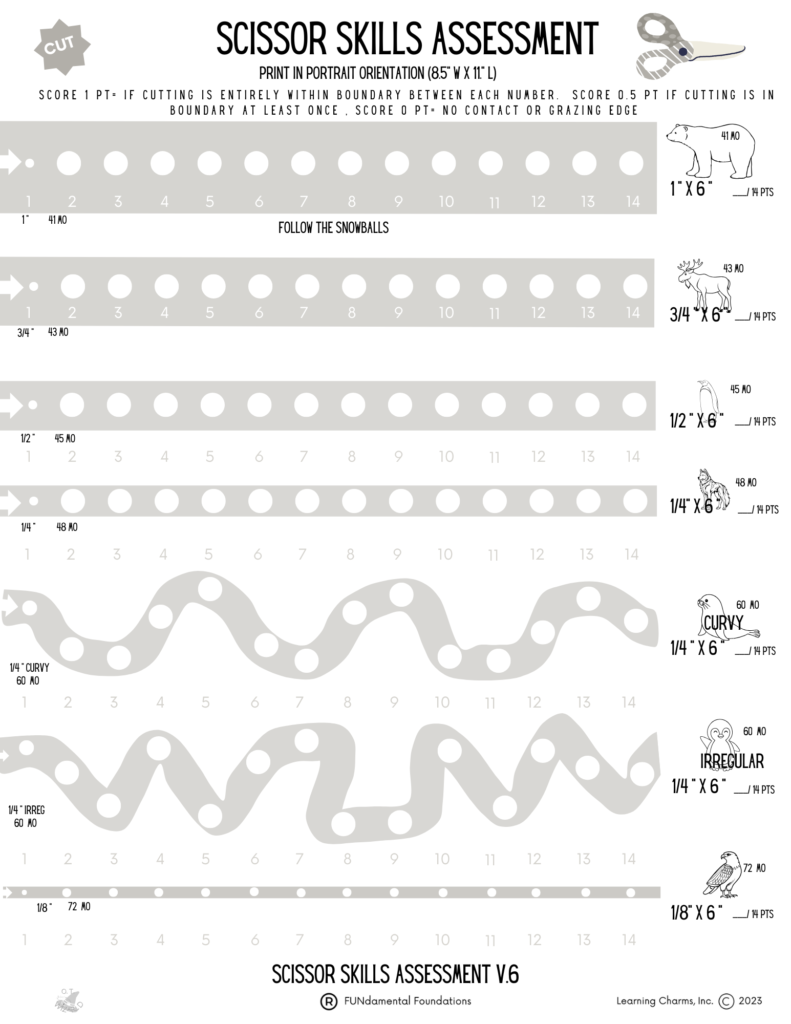
This analysis focuses primarily on FM_SCIS_48 (1/4-inch straight line), selected as the primary analytic item due to near-complete data across all age bands (n=541) and its anchor at the 48-month developmental expectation. FM_SCIS_41 (1-inch straight line) and FM_SCIS_60C (1/4-inch curvy line) were included where sample sizes permitted. Scissor type data indicated that 90.6% of children were assessed with school or safety scissors; adaptive equipment (spring-assisted, loop handle) was used in fewer than 1% of cases and is not analyzed separately.
Data Analysis
Descriptive statistics were calculated for FM_SCIS_48 by age band, dominance level, and thumb positioning group. Pearson and Spearman correlations were computed between FM_SCIS_48 and all available domain and subdomain scores. Between-group comparisons used independent samples t-tests; effect sizes are reported as Cohen d. Longitudinal analysis used paired t-tests comparing E1 and E2 scores among children with paired evaluations. A cross-sectional growth rate was used to estimate expected natural maturation over the mean evaluation interval, following the methodology established in the response-to-intervention outcomes article in this series. Artificial intelligence writing assistance (Claude, Anthropic, version Sonnet 4.6) was used in the preparation of this manuscript for language editing and formatting; all analytical decisions, clinical interpretations, and conclusions are those of the author.
All data is pre-normative. Rasch analysis validation is ongoing and will be reported in subsequent publications.
Results
Developmental Progression of Cutting Accuracy
Across all age bands, mean scores on FM_SCIS_48 increased steadily, with the steepest growth occurring between Bands G and H, the window when this skill is developmentally expected to emerge (Table 1). At Band H (the anchor age for this task), 35.6% of children in this clinical sample scored zero, reflecting the referred nature of the population. The bimodal distribution within Band H is more clinically informative than a pass/fail classification. Of 165 children scoring 10 or above on FM_SCIS_48, 162 (98.2%) were also administered FM_SCIS_60C on the same evaluation day. Among children who scored 14 on FM_SCIS_48, scores on FM_SCIS_60C ranged across the full spectrum (mean 8.61), confirming that the curvy task captures a meaningfully more demanding level of motor control.
Table 1. FM_SCIS_48 (1/4″ straight line) performance by age band. Data from a clinical sample of children referred for OT evaluation, prior to intervention.
| Age Band | Age Range | n | Mean /14 | % Score | Floor (0) | Ceiling (14) |
| G | 36-47m | 45 | 1.79 | 12.8% | 64.4% | 2.2% |
| H | 48-53m | 180 | 4.64 | 33.1% | 35.6% | 10.6% |
| I | 54-59m | 248 | 6.52 | 46.6% | 18.1% | 21.4% |
| J | 60-65m | 68 | 8.07 | 57.7% | 13.2% | 26.5% |
Hand Positioning and Hand Dominance
Dominant hand thumb-up positioning was associated with substantially higher cutting performance. Children with thumb-up positioning averaged 8.16 on FM_SCIS_48 compared to 2.74 for children without thumb-up positioning (Cohen d=1.17, p<0.001; median scores 9.0 versus 1.0). Within Band H, 28% of children who scored zero had thumb-up positioning compared to 89% of children who scored 14. No children who scored 14 on FM_SCIS_48 were rated Never for overall hand positioning quality.
Hand dominance status was consistently associated with cutting performance (Table 2). Children with established dominance scored more than five points higher on average than children with inconsistent dominance. The Spearman correlation between dominance level and FM_SCIS_48 was rho=0.360 (p<0.001). Writing-to-scissor hand consistency produced a large effect: children who used the same hand for writing and cutting averaged 7.06 on FM_SCIS_48 compared to 2.25 for children who used different hands (Cohen d=1.05, p<0.001).
Table 2. FM_SCIS_48 mean score by documented hand dominance level (Bands G-J, n=534). Dominance level based on therapist rubric rating at time of evaluation.
| Dominance Level | n | Mean /14 | % Score | Floor (scored 0) |
| Emerging | 18 | 1.50 | 10.7% | 56% |
| Inconsistent | 70 | 2.38 | 17.0% | 49% |
| Strong preference | 233 | 5.17 | 36.9% | 28% |
| Established | 213 | 7.76 | 55.4% | 16% |
Cross-Domain Correlations
Scissor cutting performance correlated significantly with all major developmental domain scores (Table 3). Fine Motor domain showed the strongest correlation (r=0.772). Visual Motor Integration (r=0.511) and Visual Perception (r=0.461) correlations reflect the visual guidance demands of cutting within a narrow boundary. The ADL correlation (r=0.511) speaks to generalization of tool use skill across daily living contexts. The Gross Motor correlation (r=0.430) reflects the role of proximal stability as a foundation for distal precision. Praxis showed the weakest correlation (r=0.271), consistent with motor planning contributing primarily to early skill acquisition rather than refined execution. The FMSAT Speed and Accuracy subdomain showed no significant relationship (Spearman rho=-0.012, not significant), confirming that scissor performance and pencil speed capture distinct aspects of fine motor control and contribute independent clinical information.
Table 3. Pearson and Spearman correlations between FM_SCIS_48 and domain/subdomain scores (Bands G-J). *** p<0.001. FMSAT Spearman correlation not significant.
| Domain / Subdomain | n | Pearson r | Spearman rho | Clinical Interpretation |
| Fine Motor domain | 454 | 0.772*** | 0.787 | Strong — cutting as fine motor expression |
| Hand Use subdomain | 541 | 0.541*** | 0.549 | Bilateral tool use as hand use marker |
| Visual Motor Integration | 537 | 0.511*** | 0.519 | Visual guidance of cutting path |
| ADL domain | 510 | 0.511*** | 0.530 | Tool use generalizes to daily living |
| Visual Perception domain | 515 | 0.461*** | 0.469 | Line discrimination supports accuracy |
| Gross Motor domain | 540 | 0.430*** | 0.444 | Proximal stability drives distal precision |
| Bilateral Integration | 538 | 0.398*** | 0.395 | Two-hand coordination demand |
| Praxis domain | 539 | 0.271*** | 0.281 | Motor planning, weaker once program formed |
| Speed & Accuracy (FMSAT) | 459 | r=-0.105* | rho=-0.012 (ns) | Distinct skill; independent clinical value |
Longitudinal Gains
Among 82 children with paired evaluations, FM_SCIS_48 showed a mean gain of 5.21 points over an average interval of 4.8 months (paired t-test t=8.10, p<0.001; Cohen d=0.895). The curvy task (FM_SCIS_60C) showed a mean gain of 3.75 points over the same interval (t=7.20, p<0.001), with 76.4% of children improving. Using the cross-sectional growth rate as a natural maturation baseline, the expected natural growth on FM_SCIS_48 over 4.8 months was approximately 1.51 points. The observed mean gain of 5.21 points exceeded this expected rate by 3.71 points. Ceiling effects were noted among children who had scored at or near 14 at E1; therapists correctly applied FM_SCIS_60C as the clinically sensitive measure for near-ceiling children in 98.2% of applicable cases.

Discussion
This analysis of 541 pediatric OT evaluations demonstrates that a brief, standardized scissor skills assessment generates clinically meaningful data across multiple dimensions of preschool development. The developmental progression of FM_SCIS_48 scores across age bands aligns with published milestone expectations and provides clinical benchmarks for a referred population that are not currently available in the literature. Floor effects in younger bands and the bimodal distribution at the anchor age band reflect the nature of scissor skill acquisition in children referred for OT services, where skill emergence is delayed relative to normative expectations. These distributions support documentation of functional deficit and medical necessity in ways that pass/fail classifications cannot.
The large effect of thumb-up dominant hand positioning (Cohen d=1.17) elevates hand positioning from a clinical observation to a primary, modifiable intervention target. Establishing correct scissor grip before focusing on path accuracy is supported by the data: children without functional thumb-up positioning have mean scores below three regardless of age band, suggesting that grip orientation is a near-prerequisite for achieving cutting accuracy at the mastery level.
The relationship between hand dominance and scissor performance connects these findings to a broader literature on neuromotor specialization in the preschool years (Scharoun & Bryden, 2014). A child who has not yet organized a consistent preferred hand for tool use is reflecting an underlying developmental state that affects performance across all tool-based tasks. Writing-to-scissor hand consistency findings have direct implications for school-based practice: addressing hand consistency across classroom tool use activities, not only during designated scissor tasks, is consistent with both the data and motor learning principles and supports IEP goal development that reflects the child’s functional performance across settings.
The cross-domain correlation profile challenges the framing of scissor skills as an isolated fine motor task. The significant Gross Motor correlation (r=0.430) reinforces that proximal stability, including trunk support and shoulder girdle control, is foundational to distal precision, consistent with developmental neuroscience frameworks (Stoodley, 2016). The VMI and Visual Perception correlations reflect the visual guidance demands of path-following. Intervention plans that address only the distal cutting task without considering foundational postural, visual, and neuromotor systems may produce slower or less durable gains. The absence of a significant FMSAT correlation confirms that scissor accuracy and pencil precision speed are complementary measures rather than redundant ones, and that both contribute independent information to a comprehensive fine motor profile.
Longitudinal gains of 5.21 points over 4.8 months, exceeding the expected natural growth rate by 3.71 points in a population with limited scissor practice outside of OT sessions, provide meaningful support for OT as a driver of skill development. This above-expected gain pattern is consistent with the RTI methodology established in this article series, which separates natural developmental progress from intervention-attributable change using cross-sectional growth rates as a baseline correction. For medical model practitioners, this framing supports quantifiable medical necessity documentation. For school-based practitioners, it provides data to support RTI tier documentation and progress monitoring language consistent with IDEA requirements.
Several methodological factors warrant consideration. This sample represents children referred for OT evaluation in North Carolina and should not be generalized to typically developing children or other geographic populations. The cross-sectional age-band comparisons reflect group differences rather than individual trajectories. Adaptive scissor data was insufficient for analysis. Without a controlled comparison group, causal claims about OT effectiveness cannot be made; above-expected gains in a referred population with limited community practice are suggestive but not definitive. Future research should include a typically developing comparison sample, session-level dosage data, and expanded age coverage through early elementary years to determine whether scissor precision continues to develop beyond 66 months and at what point the 1/4-inch straight line becomes a floor item for older children (Cameron et al., 2012; Zhang et al., 2025).
Conclusions
A structured scissor skills assessment generates clinically meaningful data for pediatric OT practice. Cutting accuracy in a referred preschool population follows a measurable developmental trajectory, is strongly predicted by thumb-up dominant hand positioning and established hand dominance, correlates significantly with fine motor, gross motor, visual motor, visual perception, ADL, and praxis domains, and shows gains that exceed expected natural growth rates over a 4.8-month evaluation interval in a population with limited community scissor access. These findings support the use of standardized, quantitative scissor skills assessment as a component of comprehensive pediatric OT evaluation and as a practical tool for RTI documentation, goal writing, and cross-domain clinical reasoning in both school-based and medical model practice settings.
Disclosure of Interest
Stephanie Seymore Wick is the Founder and Clinical Architect of O.T. Wizard, the platform from which all data in this article was collected. Data collection is ongoing under clinical quality improvement protocols. All data were de-identified in accordance with HIPAA regulations. The author reports no other competing interests.
Data Availability Statement
De-identified aggregate data supporting the findings of this study are available from the corresponding author upon reasonable request. Individual-level data cannot be shared due to HIPAA de-identification obligations.
Biographical Note
Stephanie Seymore Wick, MSOT, OT/L is the Founder and Clinical Architect of O.T. Wizard, a clinical intelligence platform for pediatric occupational therapy professionals, and the founder of Learning Charms, Inc. Her clinical and research focus is the development of psychometrically sound, computable measurement tools that quantify pediatric OT outcomes across multiple developmental domains. She practices and conducts research in North Carolina.
References
Cameron, C. E., Brock, L. L., Murrah, W. M., Bell, L. H., Worzalla, S. L., Grissmer, D., & Morrison, F. J. (2012). Fine motor skills and executive function both contribute to kindergarten achievement. Child Development, 83(4), 1229-1244. https://doi.org/10.1111/j.1467-8624.2012.01768.x
Scharoun, S. M., & Bryden, P. J. (2014). Hand preference, performance abilities, and hand selection in children. Frontiers in Psychology, 5, 82. https://doi.org/10.3389/fpsyg.2014.00082
Stoodley, C. J. (2016). The cerebellum and neurodevelopmental disorders. Cerebellum, 15(1), 34-37. https://doi.org/10.1007/s12311-015-0715-3
Zhang, B.-F., Lin, Z.-C., & Li, C. (2025). Fine motor skills assessment instruments for preschool children with typical development: A scoping review. Frontiers in Psychology, 16, 1620235. https://doi.org/10.3389/fpsyg.2025.1620235