Letter Identification and Copying Skills
A Data-Driven Investigation into How Letter Recognition and Copying Skills Actually Develop
The Question That Started It All
For decades, occupational therapists and educators have debated a fundamental question: Do children need to identify letters before they can copy them?
Traditional developmental hierarchies suggest a clear sequence: first comes letter recognition (knowing that the shape “A” is called “A”), then comes the ability to reproduce that letter through writing or copying. This assumption underlies countless kindergarten readiness checklists and early intervention programs.
But what if this assumption is wrong?
What the Research Literature Says
Recent research paints an interesting picture about the relationship between letter knowledge and handwriting. Multiple studies from 2005-2025 have established that handwriting practice enhances letter recognition. Most occupational therapists agree with that. Children who learn letters through handwriting (copying or tracing) demonstrate better letter identification on post-tests compared to those who learn by typing (Neuroscience NewsScienceDirect), and fMRI studies show that handwriting activates visual letter-processing regions in the brain more effectively than other methods(PubMed Central).
Educational researchers recommend that when students are learning letter identification, they should simultaneously engage in learning how to form the letter ( Uiowa). Writing readiness prerequisites identified in the literature include both alphabet letter recognition and basic stroke formation( Illinois) – presented as co-occurring skills rather than sequential steps.
However, here’s what’s largely missing from the research: Does letter identification actually predict copying ability? Most studies examine whether handwriting improves recognition (it does), but few investigate whether recognition is necessary for copying success.
Our Study: 471 Children, 5 Copying Tasks, Clear Answers
We analyzed assessment pre-Rasch data from 471 preschool children (ages 3-5) of a clinical sample who completed a letter copying assessment. Each child was asked to:
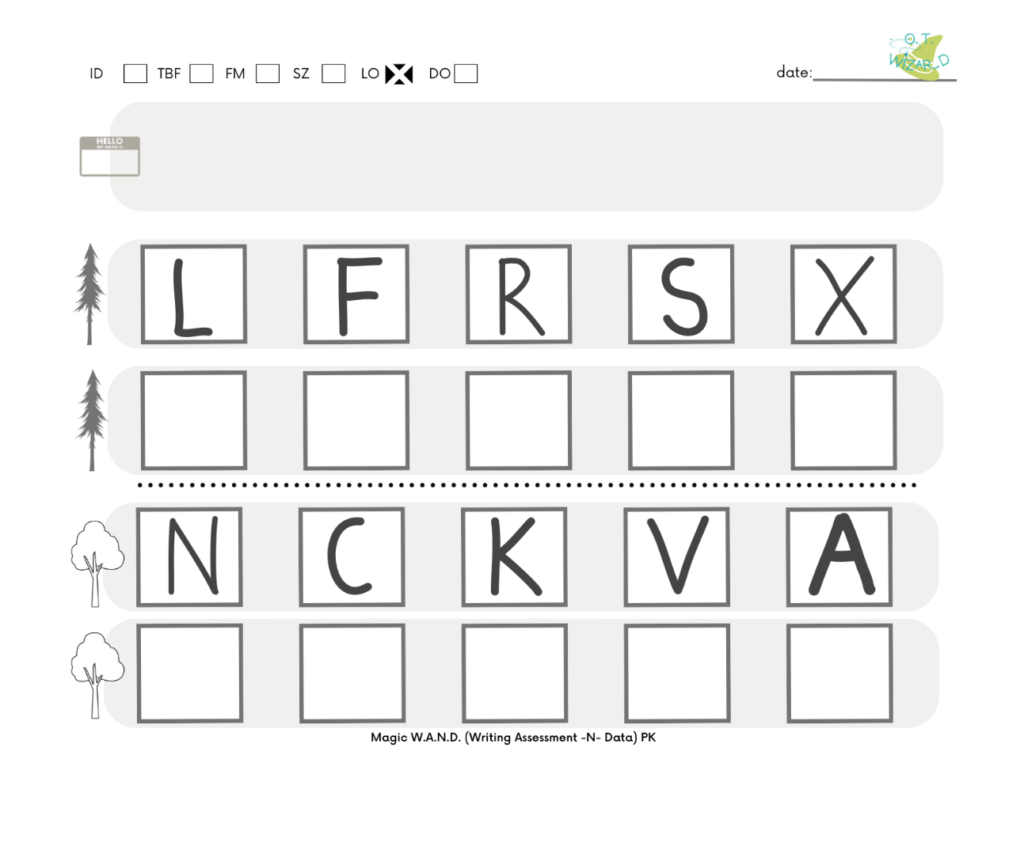
- Identify 10 uppercase letters (L, F, R, S, X, N, C, K, V, A)
- Copy 10 letters (L, F, R, S, X, N, C, K, V, A) from a visual model
For each copied letter, we scored (binary, yes/no):
- Formation: Did they use a mostly top-to-bottom stroke?
- Legibility: Was the copied letter recognizable as such?
- Directionality: Was the letter copied with correct spatial orientation?
We then calculated correlations – a statistical measure of how strongly two skills relate to each other. A correlation of 1.0 means they’re perfectly linked; 0.0 means they’re completely independent; and anything below 0.3 is considered very weak.
The Ah-Ha Moment #1: Letter ID Barely Predicts Copying
Here’s what shocked us: The correlation between letter identification and copying skills ranged from 0.05 to 0.29 across all age groups and all copying tasks.
What does this mean ?
At r = 0.29, r² = 0.08, Letter Identification explains about 8% of variance in copying performance. That’s like saying knowing someone’s height tells you almost nothing about their shoe size – the two things just aren’t that related. The graphic below shows how letter identification skills correlate to the other variables and within each age band.
| r value range | relationship |
|---|---|
| 0.0 – 0.1 | No meaningful relationship |
| 0.1 – 0.3 | Weak relationship |
| 0.3 – 0.5 | Moderate relationship |
| 0.5 – 0.7 | Strong relationship |
| 0.7 – 1.0 | Very strong relationship |
| Age Group (years) | ID →Top to Bottom Formation | ID → Legibility | ID → Directionality |
| Youngest (3:5-4:0) | r = -0.05 | r = 0.20 | r = 0.20 |
| Middle (4:0-4:5) | r = 0.28 | r = 0.19 | r = 0.14 |
| Oldest (4:5-5:0) | r = 0.23 | r = 0.29 | r = 0.17 |
Translation: Whether a child can identify a letter tells you almost nothing about whether they can copy it successfully. These are developing as largely independent skills.
The Ah-Ha Moment #2: The “Letter A Paradox”
The clearest example came from the letter A in our youngest group:
- 36.4% could identify the letter A (highest recognition rate and likely because its at the beginning of the alphabet)
- Only 5.6% could copy it with correct formation
- Only 3.7% could copy it legibly
That’s a 30-point gap. Kids knew it was an A, but couldn’t reproduce the complex diagonal strokes needed to draw one.
Meanwhile, for the letter L:
- 23.6% could identify L
- 20.4% could copy it with correct formation
Only a 3-point gap – nearly equal performance.
Why? Letter A requires two diagonal strokes meeting at a precise point with a horizontal crossbar (developmentally complex) -therefore recognition and production appear to rely on different skill demands. Letter L is just a vertical line with a horizontal base – simple enough to copy through visual matching alone, even without knowing it’s called an “L.”
The Ah-Ha Moment #3: By Age Band 4:5-5:0, Copying Can Be Easier Than Identifying
Here’s where it gets really interesting. By the oldest age group, we started seeing positive gaps – children who could copy letters they couldn’t identify:
- Letter L: 44.5% could identify it, but 63.4% could copy it correctly (+19 points)
- Letter V: 24.7% could identify it, but 44.2% could copy it correctly (+20 points)
- Directionality overall: Children performed 3.1 percentage points better at copying with correct spatial orientation than at identifying letters
This pattern defies the traditional hierarchy. Children were using visual matching – copying the shapes they saw – without needing to know the letter names.
What Does Predict Copying Success?
If letter identification doesn’t predict copying, what does?
We found that top-to-bottom formation strongly predicts legibility (correlation of 0.61-0.89, explaining 37-79% of variance).
But top to bottom formation itself correlates most strongly with:
- Visual-Motor Integration: r = 0.76 (explains 58% of variance)
- Visual Perception: r = 0.42
- Fine Motor Skills: r = 0.44
But NOT with general motor planning (Praxis): r = 0.24 (only 5.7% variance)
The takeaway: Letter copying is primarily a visual-motor integration task – the ability to coordinate what you see with what your hand does. It’s not about general motor planning, and it’s certainly not dependent on knowing letter names.
How This Compares to Existing Research
Our findings complement rather than contradict current research:
Current research says: “Handwriting practice improves letter recognition” ✓
Our data adds: “But copying ability develops independently from letter knowledge”
Current research says: “Teach letter ID and handwriting together” ✓
Our data explains WHY: They support each other but develop through different pathways – one verbal-visual (naming), one visual-motor (copying)
The key distinction: Most research examines writing from memory (where letter knowledge clearly helps), while our study examined copying from a visual model (where visual-motor integration dominates).
Implications for Occupational Therapy Practice
1. Don’t Wait for Letter Mastery to Start Copying Practice
The weak correlations (r < 0.3) mean you can’t predict copying readiness from letter identification scores. A child who struggles to name letters might still succeed at copying them.
Action: Include copying tasks in early intervention even when letter knowledge is limited. You’re building visual-motor skills that develop on a parallel track.
2. Motor Control Develops Independently
Our data showed boundary control (staying within lines) actually performed better than letter identification at all ages – evidence that fine motor control for pencil management is a separate developmental pathway.
Action: Work on “staying in the lines” without requiring letter identification first. These are independent skills.
3. Use Simple Geometric Letters as Confidence Builders
Letters L and F showed the smallest gaps between ID and copying (-3 points) because their simple vertical/horizontal geometry enables visual matching. This is consistent with programs such as Handwriting Without Tears, as they order uppercase letter instruction by geometric easy to hard.
Action: Start with L, F, T, I for early success. Save A, K, R, S (complex diagonal/curve letters) for later, regardless of which letters the child can name.
4. Target the Critical Window: Middle Preschool
Our biggest developmental gains happened between the youngest and middle age groups (Ages G→H), not between middle and oldest (H→I):
- Formation gap improved 4.6 points (G→H) vs. 4.8 points (H→I)
- Legibility gap improved 6.1 points (G→H) vs. 5.1 points (H→I)
- Directionality gap improved 8.5 points (G→H) vs. 8.4 points (H→I)
Action: Middle preschool (roughly ages 4-5) is your prime intervention window for copying skills. Don’t wait until kindergarten.
Implications for Education and Parents
1. Parallel Practice, Not Sequential Prerequisites
Old thinking: “My child needs to know their ABCs before we practice writing”
Data-driven approach: “We’ll teach letter names AND practice copying simultaneously – they support each other through different pathways”
2. Copying Success ≠ Letter Knowledge
Don’t assume that because your child can copy a letter, they know what it’s called. And don’t assume that because they can name it, they can reproduce it.
Letter A showed this clearly: High recognition, low reproduction. These are different skills.
3. The “Legibility Integration Challenge”
Legibility showed the largest negative gaps at all ages (copying legibly is 6-18 points harder than identifying letters).
Why? Legible copying requires simultaneous integration of:
- Visual perception (seeing the target)
- Motor planning (sequencing strokes)
- Motor execution (hand control)
- Visual-motor feedback (monitoring while writing)
Parenting insight: Be patient with legibility. It’s the most complex integration task and develops last. Celebrate formation accuracy and directionality before expecting neat, legible letters.
4. Use Letter Copying as a Window into Visual-Motor Skills
Since copying correlates strongly with visual-motor integration (r = 0.76) but weakly with letter knowledge (r < 0.3), copying tasks reveal visual-motor development more than academic readiness.
For educators: A child who struggles to copy letters might need visual-motor support, not more letter drills.
The Bottom Line
After analyzing 471 children’s performance on letter identification and copying tasks, the data tells a clear story: Letter identification is not a meaningful prerequisite for letter copying.
These skills develop as parallel pathways:
- Letter Identification pathway: Verbal-visual learning (naming, recognizing)
- Letter Copying pathway: Visual-motor integration (seeing, matching, executing)
Both are valuable. Both support eventual handwriting fluency. But one doesn’t have to come before the other.
For practitioners and parents: Stop waiting. Introduce copying practice early. Use simple geometric letters (L, F, E, D, P) for confidence. Target middle preschool for maximum gains. And remember – a child who can name every letter might still struggle to draw an A, while a child who can’t name any letters might successfully copy an L.
The question isn’t “ID before copying?” but rather “How do we support BOTH simultaneously to maximize letter learning through every available pathway?”
About This Research
This analysis drew from assessment data collected through OT Wizard (otwizard.com), a pediatric clinical intelligence tool. The study included 471 evaluations across three age bands (Ages G, H, I, representing 30-36 months through 60-72 months). Assessment included the preschool version of Magic WAND™ , a letter copying task with 10 uppercase letters (L, F, R, S, X, N, C, K, V, A) scored for formation accuracy, legibility, and directionality. Statistical analyses examined correlations between letter identification scores and multiple copying performance measures.
About O.T. Wizard
Data for this analysis was collected through OT Wizard, a clinical intelligence system for pediatric occupational therapy assessment. The platform evaluates performance across up to twelve domains including visual-motor integration, fine motor skills, gross motor skills, praxis, visual perception, visual motor integration, executive functioning, activities of daily living, and participation. OT Wizard is undergoing Rasch analysis validation to establish psychometrically sound, norm-referenced scoring with living norms that update continuously as the clinical database expands.
Unlike traditional checklist-based assessments, OT Wizard converts all observations to continuous metrics that enable progress tracking, cross-domain comparison, and comprehensive reporting. The platform captures all six factors identified in this research as predictive of handwriting success: fine motor skills, visual perception (with subdomain specificity), praxis, cooperation, attention, and task participation. Behavioral regulation is assessed within the context of actual task performance rather than as an isolated rating, providing clinically relevant data about how attention and cooperation affect functional skill demonstration.
For handwriting readiness assessment specifically, OT Wizard provides quantified performance across visual discrimination, visual-motor integration, fine motor control, motor planning, and behavioral engagement during writing tasks. This comprehensive approach addresses the multifactorial nature of handwriting development identified in this research. As the platform undergoes Rasch analysis validation and accumulates longitudinal outcome data, it will establish whether comprehensive baseline assessment across all six predictors improves identification of children at risk for handwriting difficulty and informs more effective intervention planning.
OT Wizard is committed to advancing the occupational therapy profession by collecting de-identified clinical data from real therapist users, building the largest developmental database in pediatric occupational therapy history. This continuous data collection enables research on developmental trends, intervention effectiveness, and response to intervention patterns that elevate practice from perception-based to data-driven decision making and strengthen the evidence base for the entire profession
For OT professionals interested in data-driven assessment tools, visit otwizard.com to learn more about evidence-based pediatric evaluation.